ASRock issues statement concerning yet another round of Ryzen 9000 CPU failures — motherboard vendor says it is 'working in seamless coordination' with AMD to investigate
The failures remain extremely rare, but the company does appear to be taking them seriously nonetheless.
Get Tom's Hardware's best news and in-depth reviews, straight to your inbox.
You are now subscribed
Your newsletter sign-up was successful
There's a rare but persistent issue with Socket AM5 processors where, occasionally, they burn out. The name that has come up the most in discussions of this issue is ASRock, which might make you think that ASRock has had the most failures. That's not necessarily a given; the tracking of the problem started on the /r/ASRock sub-Reddit, and that's why many of the failure reports are on ASRock motherboards. Given its proximity to the problem, you might expect that ASRock would have already put out a statement about it. Well, it hadn't — until now, anyway.
In an official statement published on its website's "News" section, ASRock says it is "closely monitoring recent discussions regarding the performance and behavior of AMD Ryzen™ 9000 series processors on ASRock AMD platforms." No mention of exactly what the issues are, and no specific mention of Ryzen 9 or X3D processors, either — simply, 'we heard there's a problem, and we're looking into it.' Ten-four, ASRock. This echoes a similar statement from ASUS recently, and MSI has also released remarks on the issue.
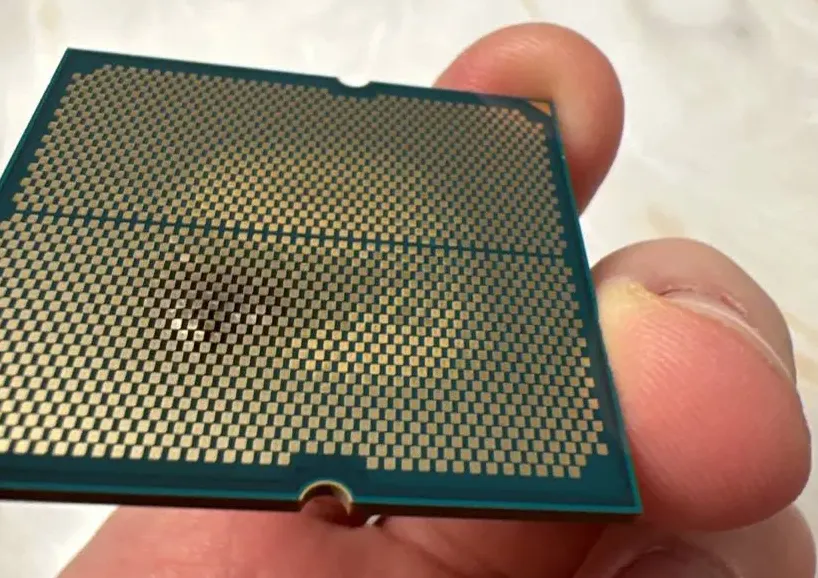
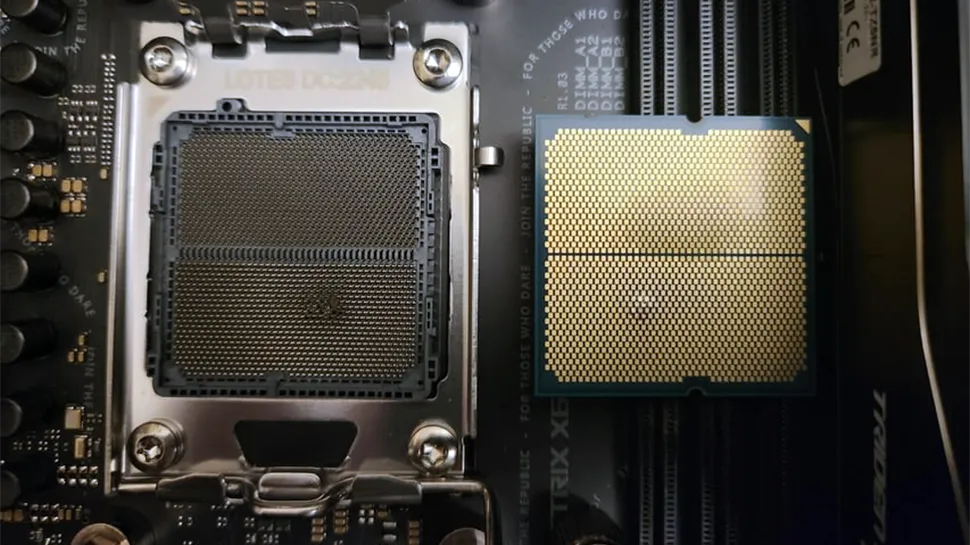
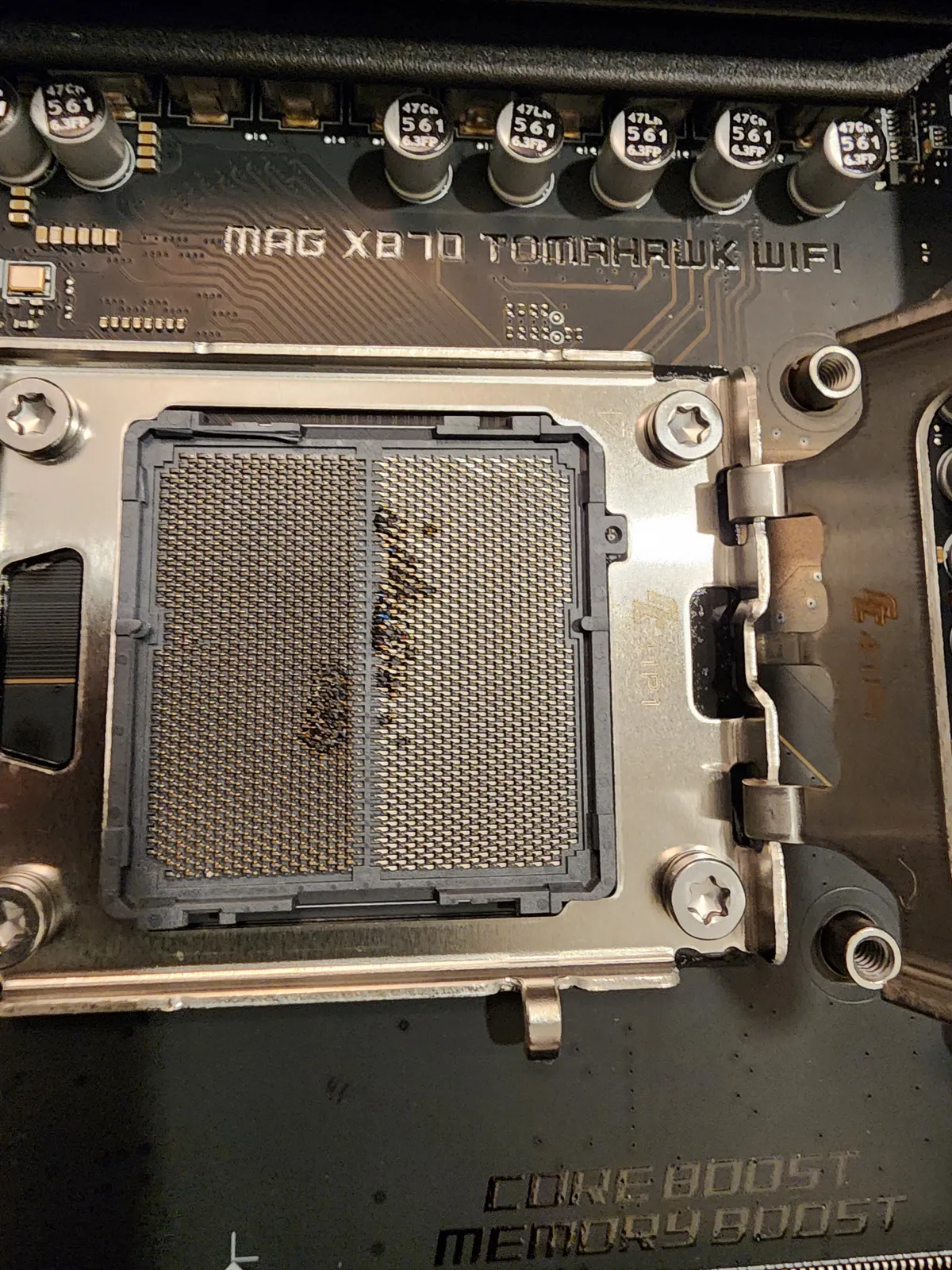
In most reports, these chips normally get so hot that they leave scorch marks on the CPU and socket. Well, they don't normally fail at all, but you understand. We don't want to overstate the frequency of this issue; at the time of writing, there are around 350 reports, which sounds like a lot until you consider both that reports are not the same as verified, root-caused failures, and also the hundreds of thousands of Socket AM5 CPUs that are out there. This problem affects an infinitesimally tiny fraction of Socket AM5 users — but that doesn't make it any less frustrating, of course.
The "burnt CPUs" issue initially plagued the Ryzen 7000 series processors way back in 2023, and last year, it was frequently framed as an issue specifically affecting AMD's "X3D" gaming processors with 3D V-Cache. While the pictures of burned processors and melted CPU sockets are certainly evocative, it's not really clear that this problem is indicative of any kind of design flaw or reproducible fault in the processors or the motherboards. ASRock issued BIOS updates aimed to minimize the issue after community outrage, but some insist that the problem persists to this day.
Hardware YouTubers Gamers Nexus have put quite a few hours into trying to intentionally cause this kind of failure, and their efforts have largely been in vain, even when using a motherboard that was known to have already killed a processor once. Much like the situation with Intel's 13th/14th-generation CPUs, it's possible there is an element of "CPU vendor offers wide range of possible values; motherboard vendor picks the most extreme possible values" here. Who's actually at fault in that case is difficult to say, but AMD is replacing CPUs that die in this manner under its standard warranty, so it's hard to find fault there, anyway.
ASRock says it is "working in seamless coordination with AMD continuously to further validate system performance across a wide range of hardware configurations, while optimizing BIOS and enhancing overall system stability." While some users see the company silently shipping BIOS updates that modify voltage behavior and power profiles as an admission of guilt, it's just as likely that ASRock wants to minimize the amount of support requests it has to field and the number of processors AMD has to replace. Given the relatively low frequency of the faults, this one is probably better filed under "unfortunate manufacturing issues" and moved away from.

Follow Tom's Hardware on Google News, or add us as a preferred source, to get our latest news, analysis, & reviews in your feeds.

Get Tom's Hardware's best news and in-depth reviews, straight to your inbox.

Zak is a freelance contributor to Tom's Hardware with decades of PC benchmarking experience who has also written for HotHardware and The Tech Report. A modern-day Renaissance man, he may not be an expert on anything, but he knows just a little about nearly everything.
-
Gururu Using adjectives like "extremely rare" or "quite small" doesn't help the situation. It's only been a year since their release and we are in the 100s (of those at least spoken to by a vocal few).Reply -
bolweval Reply
If this were Nvidia and their new connector they would saying these were on fire and needs a recall...Gururu said:Using adjectives like "extremely rare" or "quite small" doesn't help the situation. It's only been a year since their release and we are in the 100s (of those at least spoken to by a vocal few). -
spaceminions Reply
Who's they? GN has been pretty realistic about problems no matter which manufacturer they're associated with. I think you're showing your favoritism.bolweval said:If this were Nvidia and their new connector they would saying these were on fire and needs a recall... -
bolweval Reply
Who's GN?spaceminions said:Who's they? GN has been pretty realistic about problems no matter which manufacturer they're associated with. I think you're showing your favoritism.
This is Toms Hardware and I can't tell you how many headlines I've seen here about "Nividia connector catches fire!"
I don't play favorites, just calling it like i see it. Maybe your favoritism is showing? -
Marlin1975 ReplyGururu said:Using adjectives like "extremely rare" or "quite small" doesn't help the situation. It's only been a year since their release and we are in the 100s (of those at least spoken to by a vocal few).
Not only that but they are still failing after they "fixed" the issue.
I would steer clear of all Asrock until there is a real long-term solution that can be verified outside of asrock. -
DS426 We're off to the races with several of you adding no value at all to this conversation.Reply
The important things here are that:
AMD and board vendors have 1) acknowledged the issue and 2) are actively looking into it (and of course not just saying that)
AMD and board vendors aren't blaming users for "user failure" unless that can be proven
Warranties are honored (and possibly including hardware replacements even beyond warranty since it's an ongoing investigation)I don't know that ASRock necessarily has higher failure rates, or at least not statistically significantly higher, but I would have expected a response sooner; it seems like they made the announcement only because ASUS and MSI did. That's all the had to do -- say "we're looking into it" and "we'll take care of our customers." -
spaceminions Reply
I directly quote from this article "Hardware YouTubers Gamers Nexus have put quite a few hours into trying to intentionally cause this kind of failure, and their efforts have largely been in vain, even when using a motherboard that was known to have already killed a processor once." GN is Tom's citation as to people who have attempted to replicate the failure and failed. Failure to replicate this issue while easily replicating AND proposing a reasonable explanation of Nvidia's connector issue is a pretty good indication that one is not like the other.bolweval said:Who's GN?
This is Toms Hardware and I can't tell you how many headlines I've seen here about "Nividia connector catches fire!"
I don't play favorites, just calling it like i see it. Maybe your favoritism is showing? -
spaceminions Reply
Yeah, this is at the stage where everyone's just looking into things. It's pretty normal to get little satisfying info at first. Being realistic about the knowns and unknowns rather than speculating wildly is good journalism, and it was good to point out that hundreds out of hundreds of thousands is still a low percentage because that supports the idea that the failures can be difficult to replicate.DS426 said:We're off to the races with several of you adding no value at all to this conversation.
The important things here are that:
AMD and board vendors have 1) acknowledged the issue and 2) are actively looking into it (and of course not just saying that)
AMD and board vendors aren't blaming users for "user failure" unless that can be provenI don't know that ASRock necessarily has higher failure rates, or at least not statistically significantly higher, but I would have expected a response sooner; it seems like they made the announcement only because ASUS and MSI did. That's all the had to do -- say "we're looking into it" and "we'll take care of our customers."