It's rare to find Loongson CPUs outside of China, but a Linux reviewer has managed to get one of the CPU manufacturer's 12-core chips for testing. Phoronix reviewed Loongson's 12-core 3B6000 processor in a plethora of Linux-based benchmarks. Despite its high core count, Phoronix's benchmark numbers revealed that the chip can't even approach the performance of modern Western six-core chips like the Ryzen 5 9600X.
The 3B6000 was reportedly sent over to the Linux-based outlet by the Loongson Hobbyists Community. The 3B6000 came inside a 3B6000x1-7A2000x1-EVB micro-ATX with two DIMM slots, one M.2 slot, two PCIe x16 slots, and just a handful of USB ports.
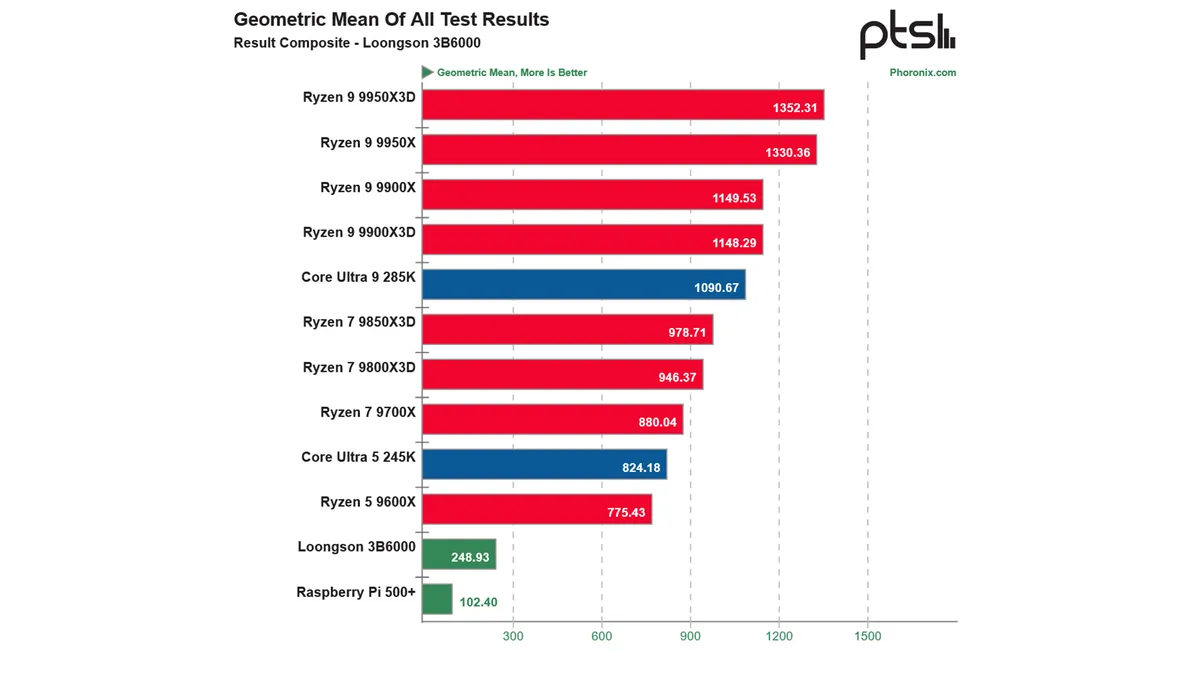
Phoronix benchmarked the 3B6000 across dozens of benchmark results, including applications with AVX-512 support. Overall, the 3B6000 was in basically last place, performing three times worse than AMD's six-core Ryzen 5 9600X. The only CPU the chip was able to overtake was the quad-core ARM CPU in the Raspberry Pi 500.
That said, the 3B6000 did not have such gloomy performance in all of the benchmarking applications Phoronix ran. For instance, in C-Ray 2.0, the 3B6000 was able to match the performance of the Ryzen 5 9600X, and in OpenSSL 3.6, it approached the performance level of the Core Ultra 5 245K. In QuickSilver 20230818, the 3B6000 managed to outperform the 245K slightly and achieve a score on par with the Core Ultra 9 285K. But these were the exceptions; in almost all other benchmark runs, the 3B6000 was significantly slower than all of AMD and Intel's x86 chips.
These performance results aren't surprising at all. The 3B6000 runs at just 2.5GHz, which is half the clock speed of most of Intel and AMD's latest chips. The Chinese chip's LA664 CPU architecture reportedly has the IPC performance of Zen 3, but the chip's abysmally slow clock speed hinders any strong IPC gains the architecture might have.
Loongson is working on newer CPU architectures that it hopes will be much faster than what the 3B6000 and its LA664 CPU architecture offer right now. Last year, we heard that the Chinese CPU maker is working on a new LA864 architecture that will reportedly to potentially have 13th/14th Gen Raptor Lake Intel CPU performance. Chips based on this architecture will also reportedly have much better clock speeds of 3 to 3.5GHz. It's still nothing close to the 5+GHz that Intel and AMD can reach, but it is a big jump for Loongson regardless.

Follow Tom's Hardware on Google News, or add us as a preferred source, to get our latest news, analysis, & reviews in your feeds.