









Why you can trust Tom's Hardware Our expert reviewers spend hours testing and comparing products and services so you can choose the best for you. Find out more about how we test.
Nvidia’s DGX Spark is a bit tough to judge at first. It isn’t meant to replace your existing PC or Mac, although it certainly could if you’re a Linux native. It's not built to be a gaming system, although it can certainly do it as a party trick.
Instead, the Spark is best understood as an AI development toolbox, a Swiss Army knife for developers, institutions, and curious local AI enthusiasts who want a stable, dependable platform to build and explore with.
The Spark’s 128GB of RAM and the solid performance afforded by its Blackwell GPU across a wide range of workloads mean that you can work without getting stopped cold by resource limitations most of the time, and for a jack-of-all-trades development sandbox, that’s mission accomplished.
Beyond the hardware, time is money in a field that’s moving this fast, and Nvidia’s thorough documentation and software support are incredibly valuable if you want to get local AI workloads up and running without spending hours digging through Reddit threads or GitHub pages to figure stuff out.
The Spark feels like a fully turn-key, professional-grade platform, and businesses and institutions that are trying to get their heads around what AI applications can do for their employees or students with minimal fuss should take notice.
The Spark is also interesting purely as a milestone in personal computing. It’s the first “real” PC built entirely under Nvidia’s direction. Here’s a fast, efficient SoC on a cutting-edge 3nm process, boasting a 20-core Arm CPU paired with a powerful Blackwell GPU using the NVLink C2C interconnect, and it all just works. There’s not a drop of AMD or Intel tech in this platform, and maybe that should keep some folks up at night.
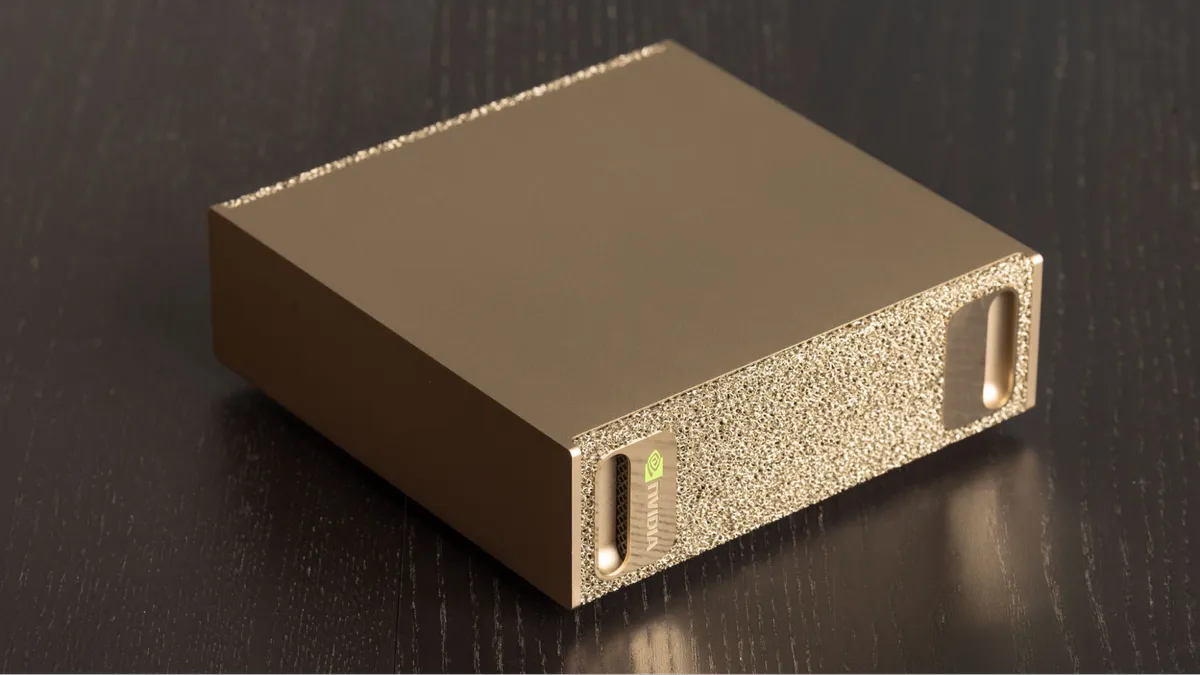
The $4,000 price tag of the Founders Edition Spark we tested might seem high on its face, but given its performance and versatility, it’s plenty competitive with other products in the market right now.
Get Tom's Hardware's best news and in-depth reviews, straight to your inbox.
If you just want a powerful local token generator with lots of RAM for the biggest models, the comparison for the DGX Spark is probably a system like Apple’s Mac Studio.
The Studio’s much higher memory bandwidth (546 GB/s vs the Spark's 273 GB/s) should result in higher tokens-per-second throughput from LLMs if that’s your sole point of interest.
You can configure an M4 Max-powered Studio with comparable amounts of RAM and storage, along with a 40-core GPU, for about $700 more than the Spark as of this writing. But the Mac Studio doesn't support CUDA, and that will be a deal-breaker for some.
AMD’s Ryzen AI Max+ 395, aka Strix Halo, platform might look comparable to the DGX Spark on paper thanks to its powerful Radeon 8060S GPU and RAM pools ranging up to 128GB. Its x86 CPU makes it great for Windows gaming in addition to AI and Linux tasks. It’s developed a reputation as the local AI enthusiast’s scrappy platform of choice.
In our experience, though, AMD’s ROCm framework still isn’t as mature or stable as CUDA despite recent improvements (at least under Linux), and the Radeon 8060S has about half the raw GPU horsepower as the Spark. Our testing revealed that its performance at long LLM context lengths and for generative workflows falls well short of GB10’s.
If you need to tinker with large AI models or agentic workflows for the lowest possible cost, Strix Halo used to be a relatively inexpensive way of getting into the game, but prices for these systems have risen sharply amid the current AI crunch. You can still configure a wide range of Ryzen AI Max+ 395 boxes with 128GB of RAM and 4TB of storage for about $3,000 from vendors like Corsair, Framework, Minisforum , and GMKtec as of this writing.
But Asus’ Ascent GX10 version of the Nvidia GB10 platform also sells for as little as $3,000 with a 1TB SSD right now, and after our testing, we’d take the Ascent GX10 any day for a general-purpose local AI system. You can drop your own 4TB M.2 2230 SSD into the GX10 and keep about $700 in your pocket versus the Founders Edition Spark we tested.
AMD is going all in on Strix Halo for local AI this year, even going so far as to create its own Ryzen AI Halo mini-PC design that’s essentially a carbon copy of the DGX Spark. But hardware is only one part of the package, and from our experience, the Spark delivers the whole enchilada right now.
As local AI workflows continue to evolve rapidly, we think the DGX Spark (and the GB10 ecosystem more broadly) is the platform you’ll want to fully explore everything that’s possible from the whirlwind of new models and applications that will surely come down the pipe as we get further into 2026.
MORE: Best Graphics Cards
MORE: GPU Benchmarks and Hierarchy
MORE: All Graphics Content

As the Senior Analyst, Graphics at Tom's Hardware, Jeff Kampman covers everything that has to do with graphics cards, gaming performance, and more. From integrated graphics processors to discrete graphics cards to the hyperscale installations powering our AI future, if it's got a GPU in it, Jeff is on it.
-
Gururu UGLY. Should have wrapped it in snakeskin leather. I'm just going to say what everyone else is saying. Can you open it up and put a picture of the innards in the review?Reply -
Pierce2623 I noticed the headline mentions beating Strix Halo, but I’m not sure it’s much of an accomplishment for a $3000 mini pc to beat a $1500 mini pc. If it doesn’t nuke Strix Halo out of existence, then it’s pretty horrible value. Since it’s currently desktop only, it should be getting compared against ITX PCs of equivalent price. Personally, I’d be comparing it against a 9950x3d/5080 ITX system, since that’s equivalent pricing. Lastly it’s a $3000 portable with no USB4/Thuderbolt? That’s next level greedy.Reply -
bit_user I'm pleasantly surprised by the analysis on Page 2. I expected to have some notes, but I think that analysis hit all of the main points. Memory bandwidth is indeed its Achilles heel. It's awesome for what was rumored to have been primarily a laptop chip, but it's got nothing on its true datacenter cousins.Reply
Yeah, it's where a big chunk of the cost comes from. I've seen street prices for that card running around $1500.The article said:... the onboard ConnectX 7 NIC running at up to 200 Gbps. That exotic NIC ...
Based on Nvidia's prior Jetson platforms, you're really stuck with this as the OS, whether you like it or not. I haven't heard how long Nvidia plans to support it, either. It's a pretty safe bet they'll move to 26.04, but who knows if they'll release anything beyond that for it?The article said:The preinstalled DGX OS is a lightly Nvidia-flavored version of Ubuntu 24.04 LTS.
Yes, and I think the ConnectX 7 NIC is a big part of that. Sad to see you didn't compare against the Ryzen AI Max 395+, here. Elsewhere, I've seen idle power of the Framework Desktop w/ Ryzen AI Max 395+ measured at a mere 12.5W.The article said:The Spark idles at about 35 W as a headless system
It really is just a happy accident that AMD created Strix Halo (Ryzen AI Max), when they did. It wasn't designed to do local LLM workloads, but rather an answer to Apple's M-series Pro. The fact that it can hang so close to GB10 is mostly a testament to just how memory-bottlenecked both are, since the GB10 has way more AI compute horsepower. -
kealii123 Reply
I'd recommend reading the entire article/reviewPierce2623 said:I noticed the headline mentions beating Strix Halo, but I’m not sure it’s much of an accomplishment for a $3000 mini pc to beat a $1500 mini pc. If it doesn’t nuke Strix Halo out of existence, then it’s pretty horrible value. Since it’s currently desktop only, it should be getting compared against ITX PCs of equivalent price. Personally, I’d be comparing it against a 9950x3d/5080 ITX system, since that’s equivalent pricing. Lastly it’s a $3000 portable with no USB4/Thuderbolt? That’s next level greedy. -
kealii123 Now I'm super curious how this chip is going to perform in the rumored consumer-oriented laptop that's supposedly shipping soon.Reply -
kealii123 I wish the review included the mentioned comparable mac studio in the benchmarks sectionReply -
colossusrage Reply
A desktop with a 5080 wouldn't even be able to run half of these LLMs, it doesn't have enough VRAM.Pierce2623 said:I noticed the headline mentions beating Strix Halo, but I’m not sure it’s much of an accomplishment for a $3000 mini pc to beat a $1500 mini pc. If it doesn’t nuke Strix Halo out of existence, then it’s pretty horrible value. Since it’s currently desktop only, it should be getting compared against ITX PCs of equivalent price. Personally, I’d be comparing it against a 9950x3d/5080 ITX system, since that’s equivalent pricing. Lastly it’s a $3000 portable with no USB4/Thuderbolt? That’s next level greedy. -
Pierce2623 Reply
If it could run normal Linux distros, you would be correct. Unfortunately it can only run special Nvidia distros. Maybe you think being locked to one proprietary OS is good but nobody else feels that way.GPTshop_ai said:It is a big pro not a con that is does not run Windows!!! Nobody should use windows. The same is true for gaming, nodody should waste their time with gaming while the elites try to mess over everyone. The only disadvantage of the DGX Spark is that it is a flimsy mini PC, that is overpriced and slow. If you can afford get something better! -
GPTshop_ai Absolutely false, any Linux distro will run on DGX Spark, but for best performace you need the special Nvidia kernel installed. DGX OS is Ubuntu 24.04 LTS BTW, but any other (ARM) distro will run just fine.Reply
PS: Soon they will rename windows to "operating system for copilot app" and it will hopefully die after that. -
GPTshop_ai Reply
Absolutely false, any Linux distro will run on DGX Spark, but for best performace you need the special Nvidia kernel installed. DGX OS is Ubuntu 24.04 LTS BTW, but any other (ARM) distro will run just fine.Pierce2623 said:If it could run normal Linux distros, you would be correct. Unfortunately it can only run special Nvidia distros. Maybe you think being locked to one proprietary OS is good but nobody else feels that way.
PS: Soon they will rename windows to "operating system for copilot app" and it will hopefully die after that.