Unreal Engine 5 has become the bane of existence for many PC gamers over the past few years. What started as a drive to push real-time graphics toward a new generation of immersion has ended up ballooning hardware requirements to the point of absurdity. However, Epic has been making steady improvements, and the latest iteration of the engine, version 5.7, seems to be the best one yet.
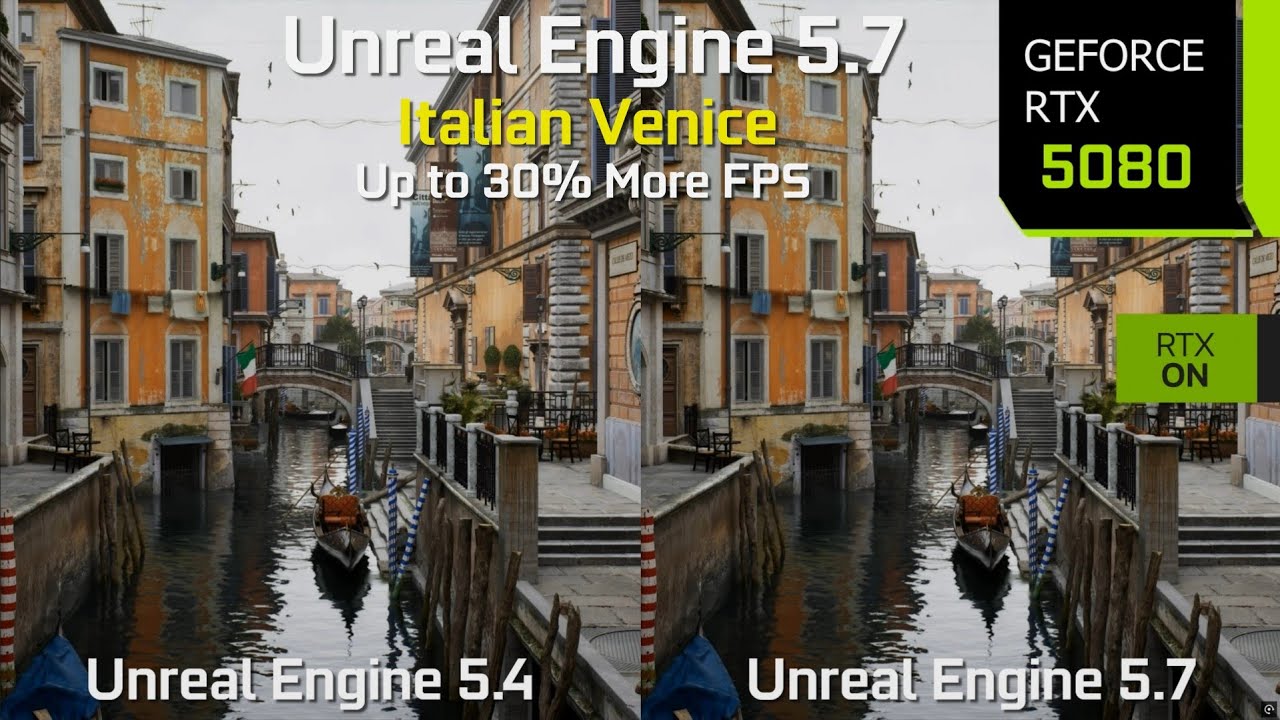

According to the OP, "GPU performance is improved by up to 25% in UE 5.7 (depending on a scene), and the 5.7 version is now better utilizing GPU resources, hence the GPU power draw is now higher." You'll see increased wattages mostly with higher-end GPUs only, as they have that extra headroom to offer.
In a CPU-limited scenario at 720p, the performance gain jumps to 35% as the UE 5.7 actually eats less RAM. This is clearly the bigger impact of UE 5.7, as MxBenchmarkPC confirms in their note, saying: "UE 5.7 offers a significant up to 35% CPU performance boost (depending on a scene) and more stable frametimes with less hitches across all scenes."

Apart from better FPS, there's a noticeable image quality improvement too, with more consistent lighting that adds to the immersion. We noticed more accurate shadows in the trees and vegetation, denser raindrops, and significantly better-looking reflections in water in certain scenes. Lumen is evidently living up to its name with this update, though its built-in denoiser is still not as good as Nvidia or AMD's solutions.
Moreover, the point of comparison, Unreal Engine 5.4, is not random here as it's notorious for being hard on GPUs, on top of having stability issues. Subsequent revisions, like Unreal Engine 5.6, have already improved upon it a lot, so a comparison between UE 5.6 and 5.7 won't look as striking — but it's great to see a step in the right direction regardless.
Borderlands 4, a game that doesn't even have a photorealistic art style and was reported to ship on Unreal Engine 5.4, made the rounds a few months back when it accidentally became the new Crysis with just how hard it was to run. The Outer Worlds followed that up with its own abysmal reports; before that, it was Hell Is Us, and the list of titles weighed down continues to grow.
Despite setbacks like these, developers still employ UE5 because it's high-quality, easy to work with, and has a mature ecosystem that far outweighs the downsides. Things like HDR, which would otherwise be another problem to tackle, are essentially just a toggle inside Unreal Engine. So, for what it's worth, Unreal Engine 5 getting more efficient is preferable over just abandoning it entirely.

Follow Tom's Hardware on Google News, or add us as a preferred source, to get our latest news, analysis, & reviews in your feeds.