









Why you can trust Tom's Hardware Our expert reviewers spend hours testing and comparing products and services so you can choose the best for you. Find out more about how we test.
The Ryzen 7 5800X3D was a weak CPU for productivity when it was released, and it hasn’t aged particularly well since then on that front. The clock speed is limited compared to non-X3D Zen 3 chips. Add to that the limitations of DDR4 platforms more broadly in non-gaming applications, and it's clear the 5800X3D was never destined for high marks here.
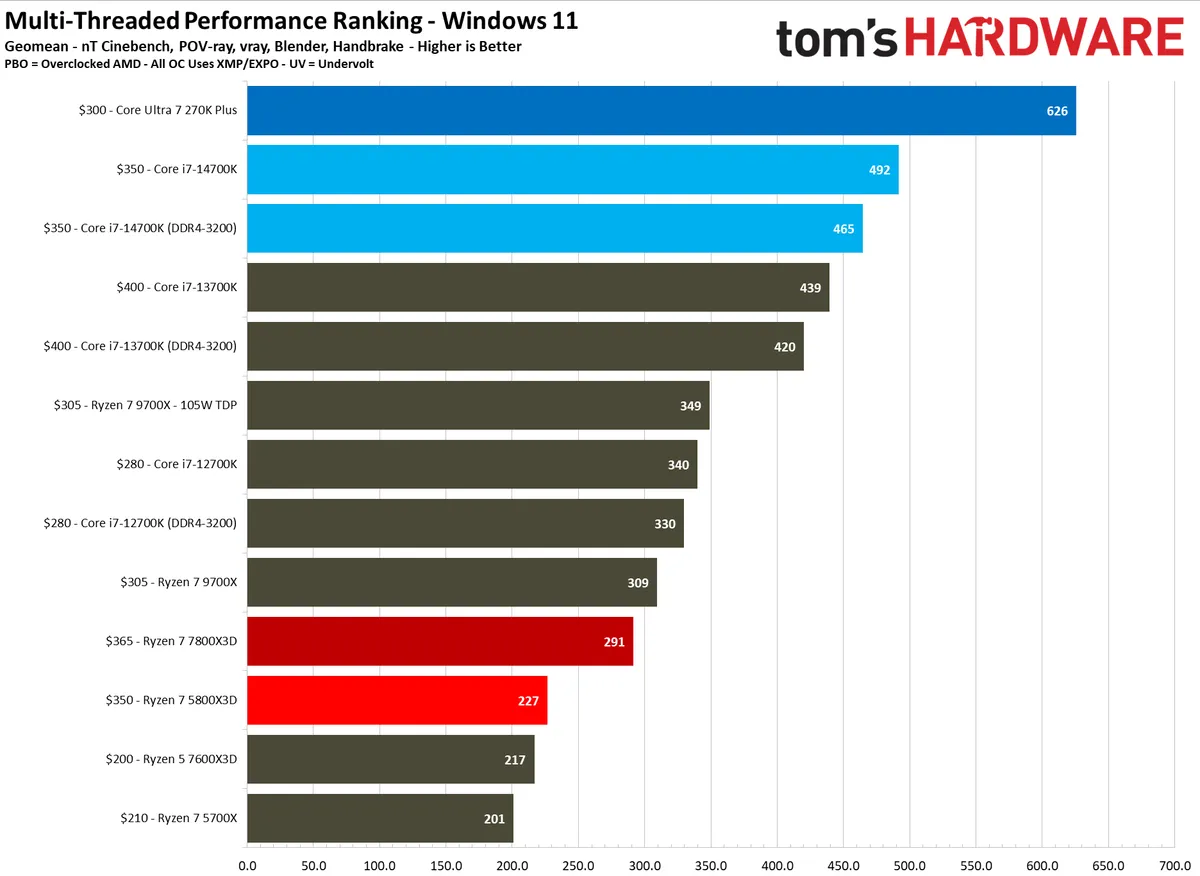
Even compared to the Ryzen 5 7600X3D, the 5800X3D is only 4.6% faster, which is bad considering the latter CPU has access to 33% more threads. Intel’s hybrid architecture boosts core counts, allowing Team Blue to dominate the top of our multithreaded performance rankings.
The CPU to call out here is the Core i7-14700K, particularly paired with DDR4 memory. It’s more than twice as fast as the 5800X3D in our multithreaded geomean, while offering similar gaming performance. Again, we can see this dilemma for the 5800X3D, where the 14700K is a better all-around CPU with DDR4, while the Ryzen 5 7600X3D is a superior DDR5 CPU for not much more money (even considering the price of DDR5).
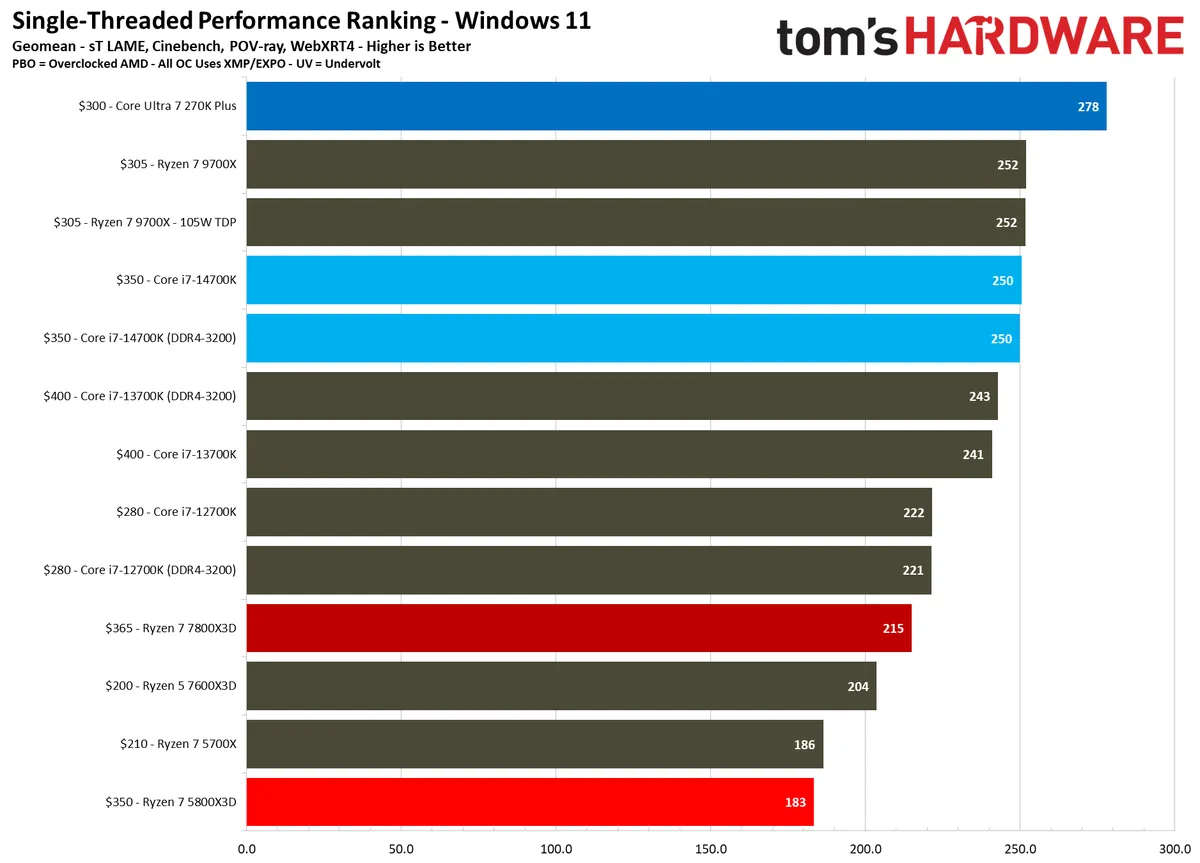
Turning to single-threaded performance, the playing field levels out, short of the 5800X3D, which even loses out to the Ryzen 7 5700X due to its limited clock speed (the 5700X boosts 100 MHz higher).
Rendering Benchmarks


View Original
View Original
View Original
View Original
View Original
View Original
View Original
View Original
View Original
View Original
View Original
View Original
View Original
View Original
View Original
View Original
View Original
View Original
Rendering apps factor heavily in our overall multithreaded geomean, so the individual results here largely mirror what you can see in the geomean above. In Cinebench 2024, the Core i7-14700K with DDR4 still offers more than double the performance of the Ryzen 7 5800X3D, and it pushes higher with DDR5. We can see a similar situation in the newer Cinebench 2026.
Single-core results are especially weak considering the Ryzen 7 5800X3D’s limited boost potential. DDR5 isn’t much of a factor here. Although we can see some scaling on the Raptor Lake platforms when moving to DDR5, the Ryzen 7 5800X3D is limited in rendering apps, even by DDR4 standards.
Blender shows similar disparities, with the six-core Ryzen 5 7600X3D largely matching the Ryzen 7 5800X3D, despite sporting a 33% reduction in thread count.
Get Tom's Hardware's best news and in-depth reviews, straight to your inbox.
The Ryzen 7 5800X3D is a gaming CPU, pure and simple, so we never expected any miracles here. However, the Ryzen 5 7600X3D is offering comparable performance on a DDR5 platform for less money, while shooting ahead in games. And the Core i7-14700K offers much better productivity performance and comparable gaming performance, even when paired with DDR4.
Encoding Benchmarks


View Original
View Original
View Original
View Original
View Original
View Original
View Original
View Original
View Original
View Original
View Original
View Original
View Original
View Original
View Original
View Original
View Original
Encoding is similarly a major factor in our geomean, though with a more even split between lightly- and heavily-threaded workloads. Starting with the latter, Handbrake is an all-out workload for any consumer CPU that leans on high core counts, power limits, and clock speeds. With an x265 10-bit encode, even the Core i7-12700K with DDR4 is 39% ahead of the 5800X3D, while the Core i7-14700K with DDR4 shoots ahead, scoring 82% lead. AV1 and X264 show similar gaps.
The LAME audio encoder provides a closer look at single-threaded encoding workloads, and once again, the Ryzen 7 5800X3D struggles. It was the worst performer in the test pool running a standard LAME encode, and the gap between it and the more performant options in our test pool only grows in the extended run.
Creator App Benchmarks


View Original
View Original
View Original
View Original
View Original
View Original
View Original
View Original
View Original
View Original
View Original
View Original
View Original
View Original
Perhaps the biggest area of crosstalk with gaming is creator applications. The Ryzen 7 5800X3D is a bit more impressive here compared to our rendering and encoding workloads, often matching the Core i7-12700K with DDR4 memory. Still, it ends up at the bottom of our rankings, with newer Raptor Lake and DDR5 CPUs offering better performance.
Photoshop is an app that leans toward AMD chips, though that’s mainly with newer Zen 5 chips. For the 5800X3D, the Core i7-14700K offers a 10% performance jump with DDR4. Things are a bit more competitive in Premiere Pro, with the limitation of DDR4 platforms becoming abundantly clear in our data.
Outside of the Adobe suite, we have DaVinci Resolve, which isn’t as lopsided as Photoshop with recent AMD CPUs. Here, even DDR4 Raptor Lake options are near the top of the chart. The 5800X3D secures a minor win over the 7600X3D and 5700X, but not by a meaningful margin.
Finally, After Effects offers a look at VFX performance. AMD’s 5800X3D especially struggles here, with the Core i7-12700K with DDR4 offering a 13% boost in overall performance. With DDR5, that lead jumps to 22.9%.
Web and Office Benchmarks


View Original
View Original
View Original
View Original
View Original
View Original
View Original
View Original
View Original
View Original
In lighter web and office workloads, the Ryzen 7 5800X3D still struggles. Most basic productivity and web applications are lightly-threaded, so it makes sense to see the 5800X3D would fall below the marks we can see in creator apps. Across all of the workloads here, the 5800X3D is either at the bottom of the pile or just narrowly outclasses the 5700X.
That doesn’t mean you’ll run into major performance issues. The workloads here are relatively light, and they’re suitable for far weaker CPUs than the Ryzen 7 5800X3D. We’re mainly looking at general application performance for browsers and lightly-threaded apps here, which is an area where the 5800X3D struggles.
Chess Engines, Compilation, Compression, AVX, and Other Benchmarks


View Original
View Original
View Original
View Original
View Original
View Original
View Original
View Original
View Original
View Original
View Original
View Original
View Original
View Original
View Original
View Original
View Original
View Original
View Original
View Original
View Original
View Original
View Original
View Original
View Original
View Original
View Original
View Original
View Original
View Original
View Original
View Original
View Original
View Original
View Original
View Original
View Original
View Original
View Original
View Original
View Original
View Original
View Original
View Original
View Original
View Original
View Original
View Original
View Original
View Original
View Original
View Original
View Original
Finally, we have a range of benchmarks examining code compilation, chess engines, database workloads, and far more. The 5800X3D is a gaming CPU, and these workloads are highly targeted at specific applications. There are some workloads where the 5800X3D shines, such as the ebizzy web server test, SQLite database test, and Linpack. However, it mostly lands at the bottom of the pile when looking at workloads more broadly.
We’ve certainly seen a benefit from a larger L3 cache for specialized workloads (see our Ryzen 9 9950X3D2 review for more), but that’s not the draw here. The Ryzen 7 5800X3D is weak in most productivity apps, so unless you plan on running a server and somehow gaming on the same machine, I wouldn’t weigh these results too heavily.
- MORE: Best CPU for gaming
- MORE: CPU Benchmark Hierarchy
- MORE: Intel vs AMD
- MORE: How to Overclock a CPU
Current page: AMD Ryzen 7 5800X3D productivity benchmarks
Prev Page AMD Ryzen 7 5800X3D Gaming Benchmarks Next Page AMD Ryzen 7 5800X3D power consumption, efficiency, test setup
Jake Roach is the Senior CPU Analyst at Tom’s Hardware, writing reviews, news, and features about the latest consumer and workstation processors.
-
Makaveli "and the processor doesn’t officially support AMD’s Precision Boost Overdrive (PBO)"Reply
This is false I owned a 5800X3D and had zero issues running PBO -30 all core on it. -
waltc3 This is AMD's way of acknowledging that due to demand outstripping supply so much presently, that even DDR4 isn't as cheap as it was, so being able to upgrade existing systems is a money-saving event of no small proportion. The whole point of the 10th Anniversary sale is strictly for people with an AM4 motherboard who are still using it (likely several million, I'd think, including a working AM4 at my home) who want to buy the fastest gaming CPU on the market for AM4, and that would be this CPU, the re-designed and re-engineered 5800x3d...;) (It's a brand-new CPU from the ground up as the original could no longer be manufactured.) Comparing it to Intel parts is really silly, I think, since none of them can drop in on an AM4 motherboard, and so if you are going to compare Intel CPUs then figure in the costs of everything else needed for the Intel CPU to run--like the mobo and the ram, for instance, etc. This release was not meant to do anything but allow existing AM4 owners to get a lot of extra mileage out of their existing AM4 parts still in service, when nothing else will do. AMD delights in treating its customers well, I think, and often goes beyond what might be expected normally for customers of previous products...;) Interesting times.Reply -
JakeRoach Reply
It depends on your motherboard. But yes, some boards support it, so I've removed the mention from the article.Makaveli said:"and the processor doesn’t officially support AMD’s Precision Boost Overdrive (PBO)"
This is false I owned a 5800X3D and has zero issues running PBO -30 all core on it. -
phxrider It's overpriced, but it's perfectly priced to sell to people who already have am4 systems and can't afford a full platform upgrade and ddr5 RAM.Reply -
ohio_buckeye Replywaltc3 said:This is AMD's way of acknowledging that due to demand outstripping supply so much presently, that even DDR4 isn't as cheap as it was, so being able to upgrade existing systems is a money-saving event of no small proportion. The whole point of the 10th Anniversary sale is strictly for people with an AM4 motherboard who are still using it (likely several million, I'd think, including a working AM4 at my home) who want to buy the fastest gaming CPU on the market for AM4, and that would be this CPU, the re-designed and re-engineered 5800x3d...;) (It's a brand-new CPU from the ground up as the original could no longer be manufactured.) Comparing it to Intel parts is really silly, I think, since none of them can drop in on an AM4 motherboard, and so if you are going to compare Intel CPUs then figure in the costs of everything else needed for the Intel CPU to run--like the mobo and the ram, for instance, etc. This release was not meant to do anything but allow existing AM4 owners to get a lot of extra mileage out of their existing AM4 parts still in service, when nothing else will do. AMD delights in treating its customers well, I think, and often goes beyond what might be expected normally for customers of previous products...;) Interesting times.
Don’t be mistaken here. I run AMD at home myself and have built a lot of AMD systems. But they are a company that needs money just like Intel and nvidia. If they see am5 sales taking hits due to ram pricing, this was a logical move. -
Droz23 I really love the analysis. On the face of the charts for the 5800x3D from the forums is can be seen how it lags after all these years but is still competitive. The really equalizer is the resolution and the bolt on Tech for GPU's. Once the test are done above 1080P, say 1440p. The Delta's shrink massively do to binding. This lets the 5800x3D stay relevant for quite awhile. the GPU manufactures serve the AI God but still have a reason to keep face in the PC market. So the tech is getting passed down for free for the most part. As drivers get upgraded, performance increases. There is still a few years left on this CPU.Reply -
Toylander Reply
I've been ummming and amming for a while now on which way to upgrade my system, it's been a shaky path since covid, I had my 3070 RTX OC sat on the shelf for a while when gpu prices went silly, and eventually moved it from my hp twin xeon workstation to an am4 platform system. I started looking at upgrading the 8gb of ram but even ddr4 is now ridiculous and used prices higher than new… is this a worthy upgrade at the cost even if I manage to sell on my used ryzen 5 5600xt or would I be better off with the am5 platform and a better cpu for less or the same with a budget board, and then spend on the minimum of ddr5 ram. With rumours or ddr4 going back into production I question if it's worth trying to skip a generation it doesn't look like ddr5 is for the consumer market at present are AMD on to something here isAdmin said:AMD has re-released the Ryzen 7 5800X3D to provide some relief from high DDR5 prices, so we’re re-reviewing the CPU to see how it stacks up to current options around the same price.
AMD Ryzen 7 5800X3D re-review: Maxing out DDR4’s gaming potential : Read more
the am4 platform is in line for a series of other upgrades? -
Dntknwitall They released the chip for people looking to upgrade that are on lower DDR4 chips so obviously they will be invested in DDR4. Whoever wrote this needs to be demoted to janitorial duties. $350 for the highest DDR4 chip for gaming is not a bad deal try buying it in Canada where it is going for $600+. I just paid 300 CAD for a 10700k to replace a 10100 chip so things are very expensive in the north and not getting better. Prices do not reflect value anymore so writting articles like they do is just dumb in my opinion.Reply -
cp0x This CPU will be back down to $250 in a few months. The retailers are being forced by AMD to set the price temporarily up to $349.99 just because that's a condition of getting any initial allocation. Stupid game by AMD that they also played with the 9950x3d2.Reply -
salgado18 So the winner is... the Ryzen 5 7600X3D? Seriously, that's the value king right now, right?Reply
Oh, and if you play at 60 fps, a 5700X is enough (for now)