When off-the-shelf cooling can't tame the world's best CPUs, you have to start thinking outside of the box. Chinese YouTube channel Geekerwan has puthe Ryzen Threadripper Pro 9995WX, a 96-core Zen 5 behemoth that costs almost $12,000, to its limits with an eye-opening DIY cooling solution. It features a custom CNC-machined integrated heat spreader (IHS), automotive-grade cooling components, an industrial chiller, and a 37-gallon water tank.
IHS modifications aren't new in hardware circles. We've previously seen the transformation implemented on processors such as the Core i9-14900KS. However, the Ryzen Threadripper Pro 9995WX is a different beast in every sense of the word. The Zen 5 flagship workstation processor isn't just substantially larger than a typical consumer chip; it also features a more complex AMD chiplet design and requires additional engineering effort.
Article continues below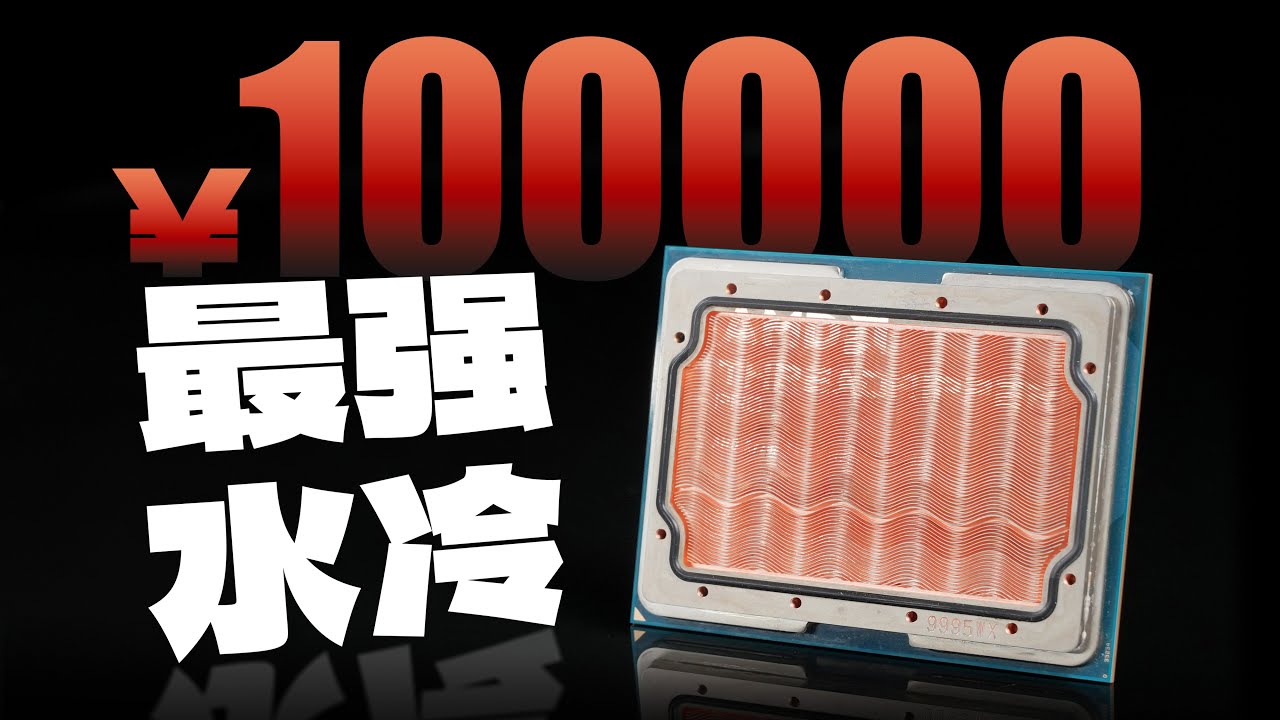
The next challenge was to select a microchannel pattern. Straight microchannels are the industry standard, but Geekerwan's computer simulations showed a better design. Since the author planned to use industrial components for the cooling solution, the liquid velocity and pressure would logically exceed those of normal liquid coolers. By adopting wavy S-shaped microchannels, the heat dissipation area can increase significantly by up to 20%.
Testing on the Ryzen Threadripper 1900X showed up to a 1.2 degrees Celsius improvement between the traditional straight and wavy microchannels. Getting the design from concept to reality was grueling. It took 19 hours of CNC machining inside the Taikan T-700S and the destruction of 14 fragile 0.3mm cutting tools to get the Ryzen Threadripper Pro 9995WX ready. The final result was a beautiful array of one hundred fins of varying lengths on the $12,000 processor's IHS.
The water block also required careful analysis. The Ryzen Threadripper 1900X and Ryzen Threadripper Pro 9995WX don't share the same design. The two CCDs in the Ryzen Threadripper Pro 9995WX sit at the chip's far edges, unlike the CCDs in the Ryzen Threadripper 1900X that cluster in the center. Due to the chiplet design and the die placement, Geekerwan needed to rethink the water block's design.
Rather than using a conventional dual-tube water block, Geekerwan tested an alternative three-tube configuration on the Ryzen Threadripper 1900X: one central inlet feeding two side outlets, one on each side. The design ensures equal heat dissipation across the two CCDs. The results were impressive, with temperatures dropping by up to 5.1 degrees Celsius compared with two-tube designs.
Geekerwan capitalized on the findings and added one additional tube produce an innovative four-tube design in a cross pattern. Liquid flows through the two central inlets, which are directly over the two CCDs, absorbs heat, and exits through the two side outlets. Powering the ambitious solution are two 50W Bosch water pumps, one salvaged from a Mercedes and the other from a Geely. Meanwhile, an industrial chiller does the heavy lifting and cools the liquid to zero degrees Celsius as the liquid flows through the loop and back to the 37-gallon reservoir.
Ryzen Threadripper Pro 9995WX Overclocking Benchmarks
| Header Cell - Column 0 | 5.3 GHz Overclock | 5.2 Overclock | PBO |
|---|---|---|---|
Frequency | 5.325 GHz | 5.2 GHz | 4.7 GHz |
System Power Consumption | 1,634W | 1,552W | 951W |
Cinebench R23 Score | 205,332 | 194,300 | 174,137 |
Cinebench 2024 | 10,080 | N/A | N/A |
Cinebench 2026 | 41,478 | N/A | N/A |
Geekerwan overclocked the Ryzen Threadripper Pro 9995WX to 5.325 GHz, drawing around 176W and idling at just five degrees Celsius. The liquid temperature was approximately two degrees Celsius, so heat transfer from the 96-core chip to the water tank was highly efficient. During the Cinebench 2024 and Cinebench 2026 runs, the processor consumed around 1,340W with core temperatures oscillating between 30 degrees and 50 degrees Celsius. The entire system was pulling a little over 1,700W.
The performance gains were logically substantial. The Ryzen Threadripper Pro 9995WX at 5.3 GHz delivered up to 18% higher multi-core performance than the stock PBO setting, which had the cores running at around 4.8 GHz. Against the global overclocking leaderboards at HWBot, Geekerwan's overclocked Ryzen Threadripper Pro 9995WX ranked 7th in Cinebench R23, a hairline behind a Ryzen Threadripper Pro 7995WX at 6.2 GHz under liquid nitrogen. In Cinebench 2024 and Cinebench 2026, the Zen 5 chip came in third and second places, respectively, and trailed a Ryzen Threadripper Pro 9995WX at 5.7 GHz and an Xeon 698X at 4.9 GHz.
Geekerwan's project shows that you don't always need exotic liquid helium or liquid hydrogen cooling to chase world records. Sometimes, a little bit of ingenuity and engineering can go a long way. But for those of us who lack access to either, we can always look forward to next-generation AIO liquid coolers, such as Cooler Master's 360² (360 x 360mm), which claims to dissipate up to 2,000W of heat.

Follow Tom's Hardware on Google News, or add us as a preferred source, to get our latest news, analysis, & reviews in your feeds.