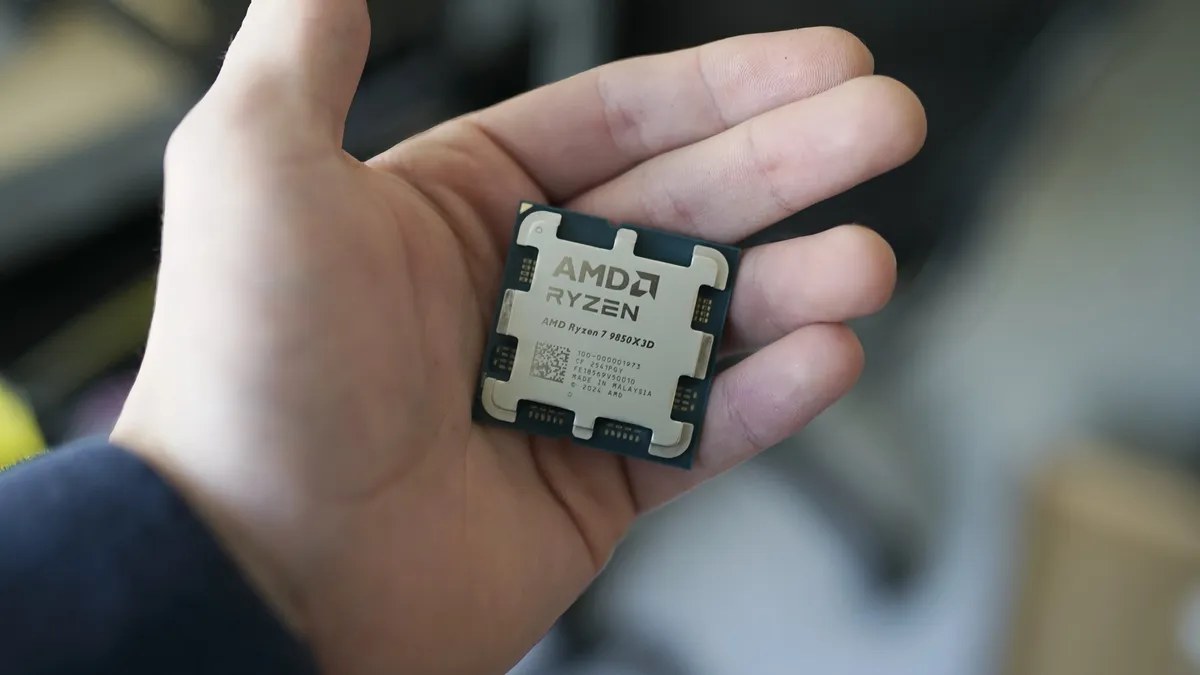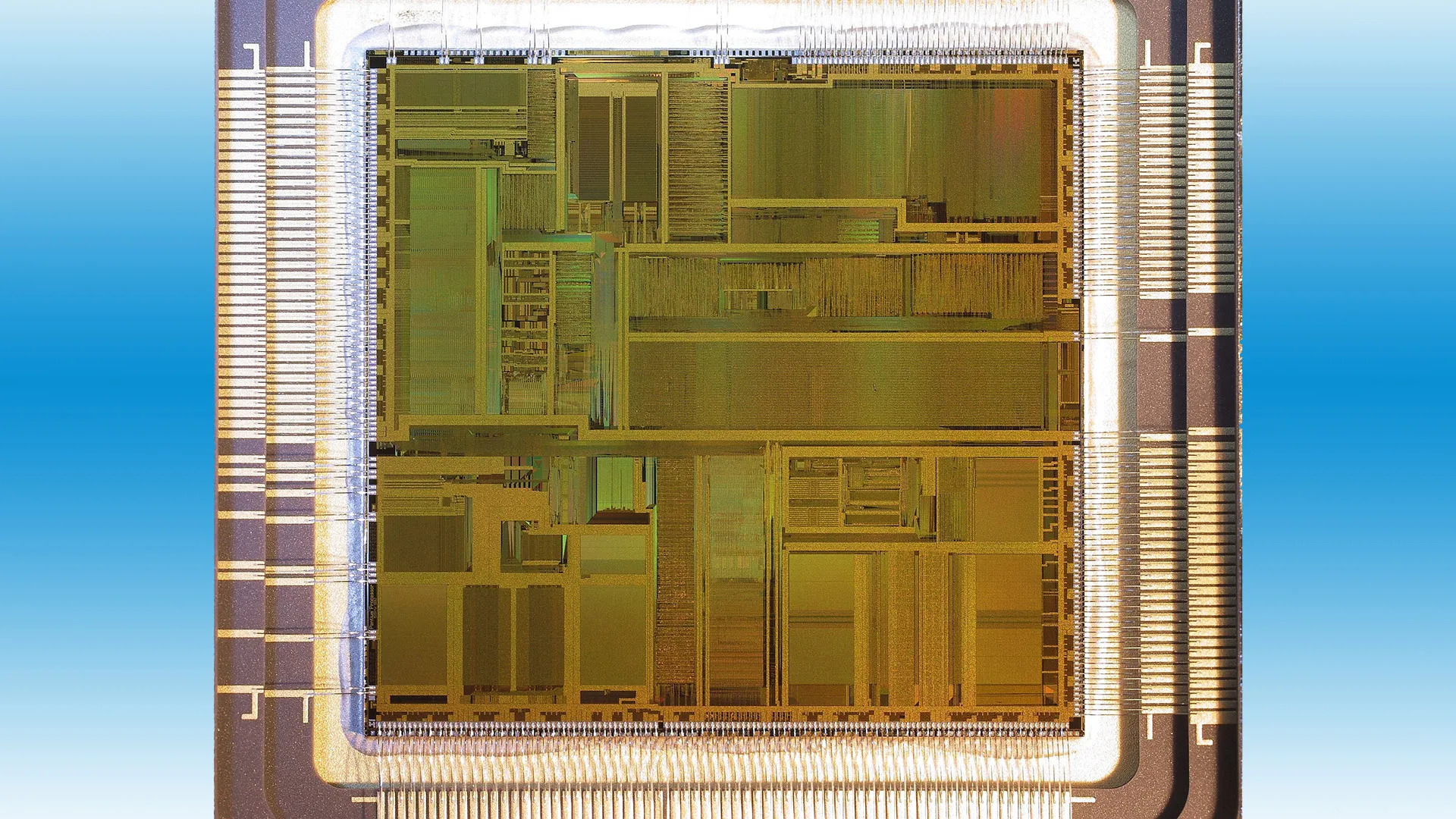
Intel released its first Pentium chip on this day 33 years ago, came packing 3.1 million transistors — fifth-gen x86 chip built on an 800nm process
This iconic CPU also boasted Intel’s first superscalar architecture, but wasn’t without its issues.
Get Tom's Hardware's best news and in-depth reviews, straight to your inbox.
You are now subscribed
Your newsletter sign-up was successful
33 years ago today, the Pentium lineage began, shaping decades of personal computing to come. The Pentium was Intel’s first superscalar design, an architectural feature that enabled the execution of multiple instructions per cycle. This would give it a boost in performance beyond its predecessor(s) despite the pedestrian sounding launch SKU clocks. Intel’s first P5/i586 architecture chips were the Pentium 60 and Pentium 66.
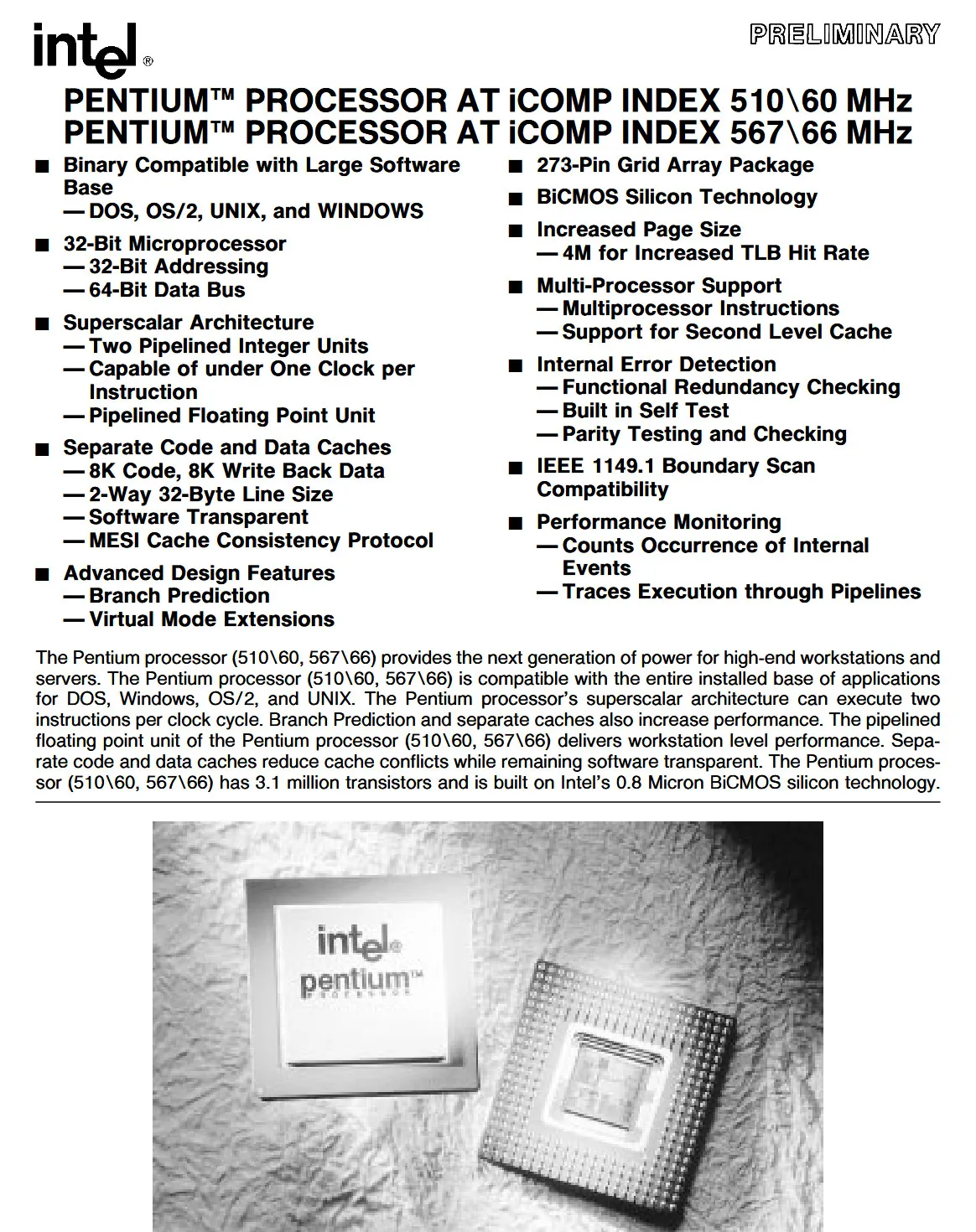
Above you can see Intel’s official data sheet for the Pentium 60 and 66. Zoom in if you want to digest the full technical specifications.
The same team that worked on the Intel 386 and 486 would drive forward the Pentium design. Work began on the chip back in June 1989, with the development team deciding to meld RISC and CISC technology with an on-chip cache, 64-bit burst-mode external data bus, fully hardware multiplier, and dynamic branch prediction. On paper, floating point operations were another strength, outperforming the i486 FPU by between three and five times.
Article continues belowIntel had planned to launch the Pentium in September 1992, but design problems were behind a delay to March 22, 1993. Sadly, they still missed some bloopers, most notably the Pentium FDIV bug. We wrote about this infamous math bug a couple of years back, on the anniversary of its discovery (discovered October 1994).
The FDIV bug episode was the first time Intel ever had to recall CPUs. It would cost the chipmaker $475 million to recall the defective CPUs, and inflicted a long-lasting stain on its reputation. Incidentally, the 30th anniversary year of the FDIV bug was also the year Intel acknowledged that Raptor Lake CPUs were frying themselves to death due to too much voltage.
Intel would refine the Pentium line the following year with the P54C, clocked at 75, 90, and 100MHz SKUs. In addition to the CPU clock boost they got a new 80502 FPU. These were fabbed at 600nm (later 350nm) switching from 5V to a lower ~3V core voltage, and the platform to Socket 4 to Socket 5.

Follow Tom's Hardware on Google News, or add us as a preferred source, to get our latest news, analysis, & reviews in your feeds.

Get Tom's Hardware's best news and in-depth reviews, straight to your inbox.

Mark Tyson is a news editor at Tom's Hardware. He enjoys covering the full breadth of PC tech; from business and semiconductor design to products approaching the edge of reason.
-
EHH9 The P60 powered my first computer. I still have the original P60 chip from that PC. It had the FDIV bug. Hard to believe that was 33 years ago. Time flies.Reply -
TechieTwo Then they eventually created the P90 "egg fryer" so you could cook breakfast on it. :(Reply -
ekio ...and 33 years later, still this crap x86 ISA in their chips, now just 33 years even more obsolete.Reply -
abufrejoval Reply
Should be interesting to get it replaced on warranty now...EHH9 said:The P60 powered my first computer. I still have the original P60 chip from that PC. It had the FDIV bug. Hard to believe that was 33 years ago. Time flies. -
Exploding PSU I miss watching the Computer Chronicles episode talking about this. That was years ago. I wonder what Stewart Chiefet is doing these days..Reply -
usertests Reply
It works well and the alternatives aren't so much better and have other hassles.ekio said:...and 33 years later, still this crap x86 ISA in their chips, now just 33 years even more obsolete. -
Nikolay Mihaylov Reply
Sadly, he recently passed away: https://en.wikipedia.org/wiki/Stewart_CheifetExploding PSU said:I miss watching the Computer Chronicles episode talking about this. That was years ago. I wonder what Stewart Chiefet is doing these days..
I guess one can say he is working in the cloud.. -
abufrejoval Reply
Evolution is like that. It doesn't reward the 'best design', just survival at every selection point.ekio said:...and 33 years later, still this crap x86 ISA in their chips, now just 33 years even more obsolete.
Just look into a mirror or at your genome: both aren't ideal in any which way, just happen to have made it through millions of years doing nothing more than surviving.
Many argue thing started to go wrong when Eckert and Maulchy put code into the same memory as data and von Neumann wrote about it, because it created all these security issues we have today. Others argue that information technology would have died without.