









Why you can trust Tom's Hardware Our expert reviewers spend hours testing and comparing products and services so you can choose the best for you. Find out more about how we test.
Comparison Products
The Corsair MP700 Pro XT has to compete against the very best drives on the market. These include the SanDisk WD Black SN8100, the Kingston Fury Renegade G5, the Crucial T710, and the Samsung 9100 Pro. We’re particularly interested in seeing how it improves upon the Phison E28 ES we previewed earlier this year and, additionally, upon Corsair’s E26-based MP700 Pro SE former flagship. To round things out, we’ve included so-called “budget” high-end drives like the Adata XPG Mars 980 Blade, which uses older flash, and the Biwin Black Opal X570, which is a unique DRAM-less solution.
Trace Testing — 3DMark Storage Benchmark
Built for gamers, 3DMark’s Storage Benchmark focuses on real-world gaming performance. Each round in this benchmark stresses storage based on gaming activities, including loading games, saving progress, installing game files, and recording gameplay video streams. Future gaming benchmarks will be DirectStorage-inclusive, and we also include notes about which drives may be future-proofed.


The MP700 Pro XT came, saw, and conquered. These are the best 3DMark results we’ve seen to date, although the drive is only a smidge faster than the Black SN8100. Most importantly, we see a significant latency improvement from our E28 ES, which takes this hardware from middling to top tier. This is peak performance for a gaming drive if you truly want the very best.
Trace Testing — PCMark 10 Storage Benchmark
PCMark 10 is a trace-based benchmark that uses a wide-ranging set of real-world traces from popular applications and everyday tasks to measure the performance of storage devices. The results are particularly useful when analyzing drives for their use as primary/boot storage devices and in work environments.


The MP700 Pro XT also sets records in PCMark 10, this time edging out the E28 ES for the top spot. The Black SN8100 also does well in this test. We again emphasize the latency results as these tend to represent real-world responsiveness or feel. The MP700 Pro XT is simply the best here with excellent application performance.
Transfer Rates — DiskBench
We use the DiskBench storage benchmarking tool to test file transfer performance with a custom, 50GB dataset. We write 31,227 files of various types, such as pictures, PDFs, and videos to the test drive, then make a copy of that data to a new folder, and follow up with a reading test of a newly-written 6.5GB zip file. This is a real world type workload that fits into the cache of most drives.


The drive’s copy performance is also excellent, matching the E28 ES and beating all other drives. There is a limit to how much performance you can eke out at the higher end of an interface speed. We think that looking at 1TB and 4TB results for this hardware would give a better impression of how it handles at different capacities, and that’s something we will certainly aim to do in the future.
Get Tom's Hardware's best news and in-depth reviews, straight to your inbox.
Synthetic Testing — ATTO / CrystalDiskMark
ATTO and CrystalDiskMark (CDM) are free and easy-to-use storage benchmarking tools that SSD vendors commonly use to assign performance specifications to their products. Both of these tools give us insight into how each device handles different file sizes and at different queue depths for both sequential and random workloads.


View Original

View Original

View Original

View Original

View Original

View Original

View Original

View Original

View Original

View Original

View Original

View Original

View Original

View Original

The MP700 Pro XT’s ATTO results are nothing short of spectacular, with a smooth curve and high throughput across the board. The T710 does beat it out for larger writes thanks to its flash, but on the whole, we put the MP700 Pro XT up there with the very best. In fact, its sequential CDM results are fantastic, with it leading in QD1 reads. Such reads reflect real-world transfer workloads. The drive simply has no weak points there.
As we move on to random performance, the drive’s 4KB QD1 read and write latency results are also top-notch. There’s decent improvement for reads over the E28 ES, bringing the drive in line with the record-setting Black SN8100. Writes are even better, leading the entire pack. This is about as close to “no compromise” as you can get with an SSD of this caliber.
Sustained Write Performance and Cache Recovery
Official write specifications are only part of the performance picture. Most SSDs implement a write cache, which is a fast area of pseudo-SLC (single-bit) programmed flash that absorbs incoming data. Sustained write speeds can suffer tremendously once the workload spills outside of the cache and into the "native" TLC (three-bit) or QLC (four-bit) flash. Performance can suffer even more if the drive is forced to fold, which is the process of migrating data out of the cache in order to free up space for further incoming data.
We use Iometer to hammer the SSD with sequential writes for 15 minutes to measure both the size of the write cache and performance after the cache is saturated. We also monitor cache recovery via multiple idle rounds. This process shows the performance of the drive in various states as well as the steady state write performance.
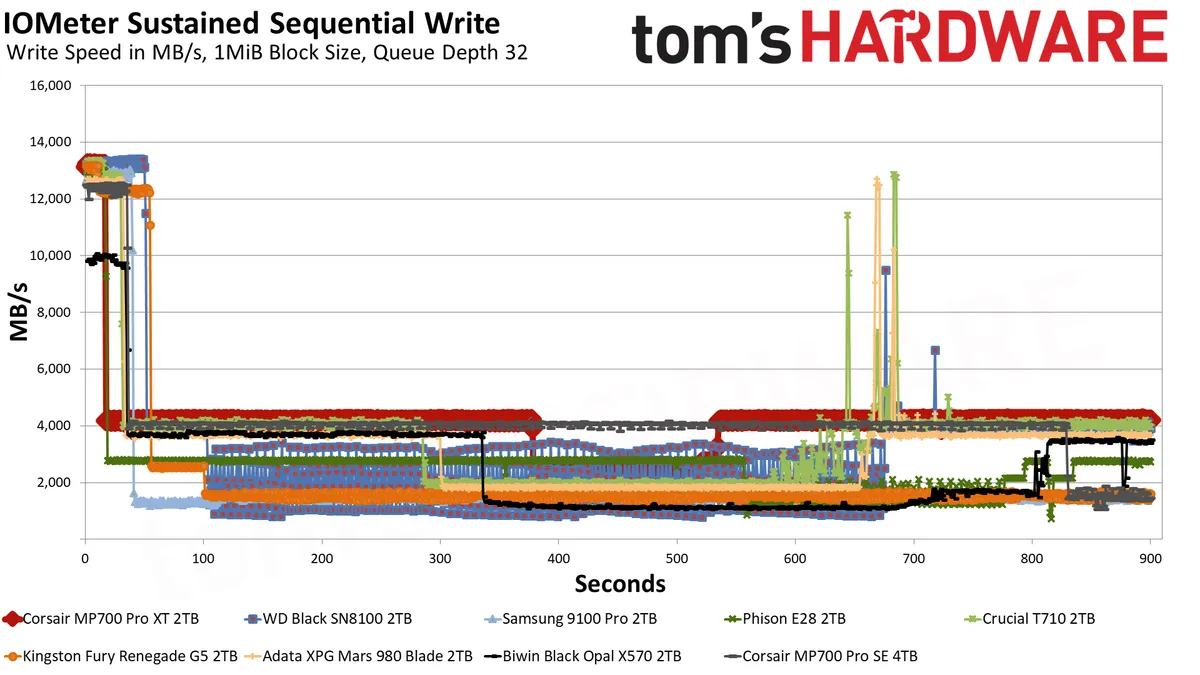


The 2TB Corsair MP700 Pro XT at first writes in a temporary, single-bit pSLC mode at 13.17 GB/s for 16 seconds. This suggests a cache of around 211TB. That’s very small for a 2TB drive by today’s standards, but it’s still plenty large enough to fit typical write workloads even when the drive is fuller. However, drives of this caliber – high-end drives selected for their bandwidth potential – need to be able to handle larger workloads, too. The smaller cache means more consistent post-cache performance, and the MP700 Pro XT demonstrates this well. It is able to hit and maintain TLC at 4.2 GB/s for a prolonged period of time. This is the best result we’ve seen outside of the Sabrent Rocket 5, and it beats both the T710 and Black SN8100.
While there is an eventual “folding” state – when the drive is still tackling incoming writes and is unable to empty the cache fast enough to free up space for new data – it is relatively brief and still manages up to 1.96 GB/s on the whole. Folding performance tends to be at or below half the TLC mode performance since you have to write twice with a read in between, and the extra steps increase latency. 1.96 GB/s in this folding mode, which is basically the worst-case performance state, is pretty good, and it finally demonstrates the full capability of the BiCS8 flash. Some may be disappointed by the small cache, but that’s the price you pay for this level of consistency. Given the rest of the results, we think this is a capstone as it means there are no real weak areas for this drive.
Power Consumption and Temperature
We use the Quarch HD Programmable Power Module to gain a deeper understanding of power characteristics. Idle power consumption is an important aspect to consider, especially if you're looking for a laptop upgrade, as even the best ultrabooks can have mediocre stock storage. Desktops may be more performance-oriented, with less support for power-saving features, so we show the worst-case scenario.
Some SSDs can consume watts of power at idle while better-suited ones sip just milliwatts. Average workload power consumption and max consumption are two other aspects of power consumption but performance-per-watt, or efficiency, is more important. A drive might consume more power during any given workload, but accomplishing a task faster allows the drive to drop into an idle state more quickly, ultimately saving energy.
For temperature recording we currently poll the drive’s primary composite sensor during testing with a ~22°C ambient. Our testing is rigorous enough to heat the drive to a realistic ceiling temperature.


View Original

View Original

View Original

View Original

We knew this drive would be power-efficient from our E28 preview and the drive's launch specifications. However, we ended up being impressed by just how well this drive runs. It’s the most efficient drive we have on record, and it has none of the idle power-consumption problems that the older E26 had – see the MP700 Pro SE for a comparison. This hardware has been optimized to an incredible extent, and we would have to say we finally have a drive that puts the Black SN8100 in its place.
This efficiency carried over to heat production as well, with a maximum reading of just 59°C. This is almost 30°C below the first throttling point, although that point is very close to the critical temperature. The E26 on launch had some problems when it got that hot, which was easy to achieve if a drive was run without a heatsink. Phison later smoothed this out to some extent, but the drives always needed a heatsink. We can happily say that this is no longer true – the MP700 Pro XT can run without a heatsink and, in fact, should be fine in a laptop.
Test Bench and Testing Notes
CPU |
|
Motherboard |
|
Memory |
|
Graphics |
Intel Iris Xe UHD Graphics 770 |
CPU Cooling |
|
Case |
|
Power Supply |
|
OS Storage |
|
Operating System |
We use an Alder Lake platform with most background applications such as indexing, Windows updates, and anti-virus disabled in the OS to reduce run-to-run variability. Each SSD is prefilled to 50% capacity and tested as a secondary device. Unless noted, we use active cooling for all SSDs.
Corsair MP700 Pro XT Bottom Line
The Corsair MP700 Pro XT is everything a high-end SSD should be – massively powerful with good performance in every benchmark without any drawbacks. It is record-setting or record-tying in just about all of our tests, with great performance in the ones we think matter the most, like 4KB random I/O and sustained write consistency. On top of that, it has fantastic power efficiency in a single-sided form factor that’s cool enough for a laptop or portable gaming device. If you have to buy just one SSD, right now this is probably the one to get.
This sounds like an advertisement for a perfect score, but we do have some minor concerns about the product. The first is centered on price, as high-end drives hold a significant premium, and the current memory market is challenging to say the least. The MSRP and current pricing for the available capacities are not unreasonable, so we can’t really put that down as a negative. It’s just that we would expect this drive to be more expensive than, say, the SanDisk WD Black SN8100, our previous champion. That would be fine in our book, but we don’t have other E28-based drives to make a good comparison. We’ll have to wait and see if this drive can maintain its value.
The second issue is that we’re not seeing an 8TB SKU right away. This is completely expected as Phison has that planned for 2026, and in the current market, you’re asking a lot for that much storage. Considering that this drive is single-sided and has a very low relative power draw, stopping at 4TB makes a lot of sense. Going to 8TB will require a double-sided design, and the power draw is going to be higher to meet these performance requirements. Further, the 8TB Samsung 9100 Pro has been on sale at a price that would be very difficult to compete against, although the Black SN8100 is a possible second candidate there. For this reason, we would recommend one of those two drives – the 8TB Black SN8100 is on its way – if capacity is your number one priority.

One problem that is avoided is weak performance at lower capacities. Previously, only the Crucial T710 really made sense at 1TB, given drive specifications. The MP700 Pro XT changes this analysis by maximizing parallelization even with a relatively low flash die count. We’re left with the distinct feeling that this drive is perfect at all of its available capacities, which is unusual. This puts a lot of pressure on existing SM2508-based drives, especially the ones with older Micron flash, to cut prices. That’s good news if your priority is budget, as you can still get high-end performance from other drives if you’re willing to compromise to save some money.
Speaking of the flash, the MP700 Pro XT’s use of BiCS8 instead of Micron TLC is an extra bonus. BiCS8 has delivered excellent random 4KB read results, and that remains the top area to look at for the best “feel” or responsiveness of the drive in everyday use. This drive will give you a sublime experience, on par with the excellent Black SN8100. The controller is also able to get the most out of the flash with a conservative pSLC cache, which means high TLC write speeds for a more consistent post-cache experience. While this is not ideal for all scenarios, it does mean that you can expect the drive to remain responsive even in edge cases. The combination of these two design decisions means the MP700 Pro XT will feel like a high-end drive in basically all situations.
In fact, this hardware could earn a perfect score from us under the right circumstances. We think Phison was right to delay the release of its controller, as the optimization is nothing short of phenomenal and well worth the wait. However, the timing isn’t great, given the sudden surge in memory demand and the fact that the Black SN8100 has been impressive and affordable for months now.
Corsair should be applauded for putting its drive out first among the E28s, but it could have had more flair even though it doesn’t really need it. For example, offering the option of a heatsink for a small fee would be appreciated even though the drive doesn’t require one. Corsair stuck to the essentials here, and in a small way, that’s the better approach, but some users might expect more. Frankly, we think the drive is about as good as it gets, and we look forward to seeing what the competition can bring forth.
MORE: Best SSDs
MORE: Best External SSDs
MORE: Best SSD for the Steam Deck
- 1
- 2
Current page: Corsair MP700 Pro XT 2TB Performance Results
Prev Page Features and Specifications
Shane Downing is a Contributing Writer for Tom’s Hardware, covering consumer storage, PC hardware, and AI.
-
philged Two items:Reply
You say "the Samsung 9100 Pro remains the best and only 8TB retail option;" however that's no longer true as the WD 8100 now has an 8TB retail option.
On the second page in Trace Testing 3D Mark Storage Benchmarks, you say "These are the best 3DMark results we’ve seen to date, although the drive is only a smidge faster than the Black SN8100" Yet the chart right above that shows the MP700 equal to or slower than the 8100 in every test? -
Amdlova That ssd has 3kk of sequential reads almost 15gb/s...Reply
Almost screaming at the user this is speed!
And the ramdon reads? 3k lol not better than A2 micro sd card . -
JarredWaltonGPU You've got the Quarch power charts in the steady state write saturation gallery (so the charts are there twice). Great to see steady state performance hitting 4.2 GB/s, incidentally! Now if only NAND and DRAM prices weren't going in the wrong direction... :'(Reply -
Soul_keeper Does anyone know if Corsair allows users to upgrade firmware with a bootable disk/image ?Reply
As a linux user, this has been one of the big reasons for avoiding anything not samsung or micron.
I recently bricked a 2TB kingston nvme drive trying to use experimental linux software to upgrade the firmware because they don't offer a bootable safe option and I have not owned windows in over 20 years. -
Paul Alcorn Reply
Thanks, Jarred. :PJarredWaltonGPU said:You've got the Quarch power charts in the steady state write saturation gallery (so the charts are there twice). Great to see steady state performance hitting 4.2 GB/s, incidentally! Now if only NAND and DRAM prices weren't going in the wrong direction... :'(
Are you going to be at CES? -
JarredWaltonGPU Reply
You know it! Party at the Phison suite. :DPaul Alcorn said:Thanks, Jarred. :P
Are you going to be at CES? -
Makaveli Other than the small cache this drive looks like a total winner just price will be high will keep an eye on it in 2026.Reply -
jongri Reply
You are aware that SanDisk lists the specs on the 8TB version of their WD Black SN8100 as Seq. Read 14,900 MB/s, Seq. Write 13,200 MB/s (not 14,000 MB/s like the two smaller capacity WD Black SN8100 2TB-4TB SSD you reference in Benchmarks and the 8TB Samsung 9100 Pro SSD beats the 8TB WD Black SN8100 like a drum in every metric that counts. So does this Corsair MP700 Pro XT up to the 4TB capacity easily beats all versions (1TB, 2TB, or 4TB) WD Black SN8100. They both have the same Seq. Read 14,900 MB/s, but the 2TB-4TB WD Black SN8100 has a lower Seq. Write of 14,000 MB/s and all 4 SanDisk WD Black SN8100 capacities 1TB-8TB have much slower Random Read 2.3M IOPS (2.2M IOPS Random Read for the WD Black SN8100 8TB) and Random Write of only 2.4M IOPS verses the new speed King Corsair MP700 XT with much higher Random Read 2.7M IOPS and Random Write 3.3M IOPS & Seq. Write 14,500 MB/s.philged said:Two items:
You say "the Samsung 9100 Pro remains the best and only 8TB retail option;" however that's no longer true as the WD 8100 now has an 8TB retail option.
On the second page in Trace Testing 3D Mark Storage Benchmarks, you say "These are the best 3DMark results we’ve seen to date, although the drive is only a smidge faster than the Black SN8100" Yet the chart right above that shows the MP700 equal to or slower than the 8100 in every test?
Face it @philged I too was once a SanDisk WD Black SN8100 Fan boy like you" but these newer Gen 5 M.2 SSDs based on the Phison E28 ES Controller are going to be faster than the really fast but older, former fastest 2TB SanDisk WD Black SN8100 SSDs.
Higher Random Read IOPS & Random Write IOPS usually equates to Real World Speed when combined with a higher Seq. Write of 14,500 MB/s & more importantly a much higher Sustained Write over the slower SanDisk WD Black SN8100 (all 4 capacities). All Hail the new 2280 M.2 NVMe Gen 5 SSD Speed King the Corsair MP700 Pro XT SSD (All 3 capacities 1TB, 2TB & 4TB)! Best of all is having this speed while using less power, staying cooler (less thermal throttling), and being priced cheaper than the SanDisk WD Black SN8100 SSDs makes this a no brainer. . -
bit_user Reply
Maybe the author meant to say PCMark10 Storage, as this drive does post up top marks in all those tests. As for 3D Mark, you are correct.philged said:On the second page in Trace Testing 3D Mark Storage Benchmarks, you say "These are the best 3DMark results we’ve seen to date, although the drive is only a smidge faster than the Black SN8100" Yet the chart right above that shows the MP700 equal to or slower than the 8100 in every test?