









AMD Shows Live Demo of Trinity APU With Eyefinity Gaming
AMD has a good tradition of live demos behind closed doors and this year's CeBIT was no different.

Whenever we're at CeBIT in Hanover, or IFA in Berlin, we visit AMD and ask nicely if they have anything new and exciting to show us. At IFA 2010 it was Brazos, at CeBIT 2011 it was Llano, and last year’s IFA brought us an early look at Bulldozer. So, what did AMD give us this year? Two things, actually. For one, we got a look at AMD’s upcoming Trinity APU in action – and for another, a video of said demo that we’re actually allowed to show you guys.
AMD’s Saša Marinkovic kicked off by giving us an rundown on what to expect during the next couple of months. As we already know, the second-generation APU code-named Trinity will be arriving in summer, with exact dates to be announced. The same goes for the tablet-bound Hondo and Brazos 2.0, which will be updated with TurboCore and USB 3.0. Those last two will still be built on a 40 nm process, but by next year, AMD says all of its parts will be 28 nm.

Trinity, of course, will be the first APU to incorporate CPU cores based on the Bulldozer architecture in its second incarnation dubbed Piledriver, and it will be manufactured on a 32 nm process node. On the other hand, the graphics section will also be updated to include a newer core, bringing with it a few new features. Among them are various video enhancements as well as VCE, the video codec engine we’ve told you about in the desktop parts of the Radeon HD 7000-series. Color correction algorithms, image stabilization and similar features will also be improved on the new APU. Despite this, the graphics core will still employ AMD’s VLIW4 instruction found in the Radeon HD 6900-series.

In the notebook space, Trinity will be available in two flavors, namely the ULV version with a TDP of only 17 W and a mainstream variant rated at 35 W. AMD promises that the ULV edition will offer all of the performance of last year's mainstream Llano while retaining all of the features of the mainstream part. Or, as AMD puts it, it will be the only premium quad-core APU in the ULV segment, allowing notebook makers to put AMD chips in their thin and light designs, bringing us Trinity-powered Ultrabooks.

The chipmaker also presented a few interesting if vague metrics for the mainstream and desktop versions. According to the slide we were shown, "productivity performance," i.e. anything to do with the CPU, is 29 percent higher on Trinity than on its predecessor, while "visual performance" is up by 56 percent. These results are based on Futuremark’s PCMark Vantage and 3DMark Vantage, respectively. For the notebook platform, AMD claims a "resting battery life" of more than 12 hours.

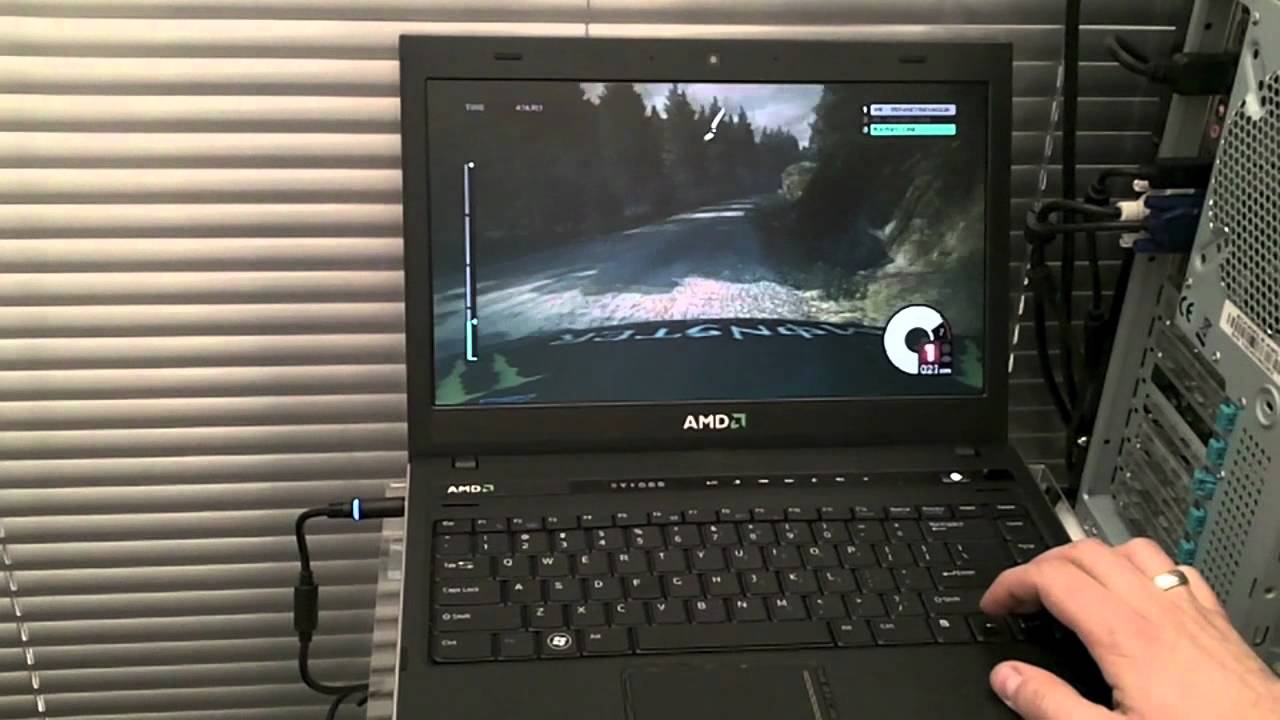
That brings us to the live demo. This year, AMD only showed us one demo, namely two systems running DiRT 3. Unfortunately, we aren’t allowed to talk about what was in the two demo systems beyond the fact that both were equipped with quad-core Trinity parts, and we can’t give you hard performance numbers for the demo runs, as AMD made sure not to show us any frame rate counters.

First up was a laptop based on the mainstream mobile platform, i.e. the 35 W part, running the racing simulator at 1366x768, 4xAA with High Details. While the system didn’t show a frame rate counter, we can tell you that gameplay was quite smooth.
Get Tom's Hardware's best news and in-depth reviews, straight to your inbox.
The second system used the desktop version and was also running DiRT 3, driving an Eyefinity setup with three monitors using only its integrated GPU. As Saša says in the video, the resolution is set to "16 by 10," which would make it 5040 x 1050 across three monitors. The detail level was lower, and AA was off this time. Granted, this is nothing for enthusiasts to get excited about, but seeing an integrated graphics solution run a modern DX11 game on a three-screen setup was pretty impressive.
Here's the demo video:

-
wiyosaya It will be interesting to see benchmarks on Trinity. For the time being, it seems like AMD has a winner in the laptop market. I hope, however, that they keep on top of development so that Intel does not catch them with their pants down.Reply -
alikum ekleruson the GPU side why they don't push it a little further they have the tech alreadyHow much further can they push while keeping the chip under 35W? Also, when they designed Trinity, 7000-series wasn't even developed yet.Reply -
zeratul600 This is cool, im sorry if i sound stupid but it is possible to have an apu like this on motherboard with 4 pci express slots so i can keep adding gpus as time goes by (and gather enough money)Reply -
-Fran- memadmaxAt 1:27.....Ooops.Reply
Current Llano heats a lot in desktop, so they better come up with better HSFs this time around for the Boxed ones. Also, it's pretty darn impressive that it can push 3x 1680x1050 monitors in eyefinity, even with the artifacts, lol.
Cheers! -
Wisecracker Replyon the GPU side why they don't push it a little further they have the tech already
How much further can they push while keeping the chip under 35W? Also, when they designed Trinity, 7000-series wasn't even developed yet.
With Trinity, AMD is rumored to have made significant improvements in 'dual-graphics' -- combining the APU with a discreet card (HD 6570 Turks Pro if I remember correctly).
If true, this should have a substantial impact on both the mobile and desktop space.
TrinityII in 2013 is rumored to be the GCN derivative in the APU (and presumably, dual-graphics). Remember that Cape Verde at 28nm brings some interesting things to the table -- the long-idle state and advanced 'Power Tune' being prominent.
When you consider their re-engineering of the Compute Units on GCN, it gives you a idea of where they ultimately want to go with all this.