If you have a taste for higher-end fare and a good understanding of the strengths and weaknesses, the Ryzen 7 5800X3D is an impressive chip that delivers leading-edge gaming performance and leaves room for future GPU upgrades, making it the best CPU at its price point for gaming-focused rigs.
Pros
+
The fastest gaming CPU money can buy
+
Competitive price
+
Support for PCIe 4.0
+
Compatible with AM4 motherboards
+
Passable single- and multi-threaded performance
+
Low power consumption
Cons
-
No overclocking support
-
No bundled cooler
-
No integrated graphics
-
Not as strong as competing chips in desktop PC applications
Why you can trust Tom's Hardware
Our expert reviewers spend hours testing and comparing products and services so you can choose the best for you. Find out more about how we test.
The battle for gaming supremacy between Intel and AMD has never been as intense as it is now, but AMD has a new ace in the hole. AMD's $449 Ryzen 7 5800X3D uses new cutting-edge 3D-stacked SRAM technology, called 3D V-Cache, to enable a total of 96MB of L3 cache that unlocks tremendous gaming performance, unseating Intel's expensive $738 Core i9-12900KS as the fastest of the Best CPUs for gaming — but at a more forgiving price point. AMD pulled this feat off with an eight-core 16-thread chip based on the same 7nm process and Zen 3 architecture as the original Ryzen 5000 chips that debuted back in 2020, but uses an innovative hybrid bonding technology to fuse an extra slice of cache atop the processing cores, a first for desktop PCs.
The Ryzen 7 5800X3D represents the company's last hurrah for its long-lived Socket AM4 platforms that have shepherded the Ryzen chips from their infancy with the Ryzen 7 1800X in 2017 to their once-dominating position at the top of our CPU benchmark gaming hierarchy last year with the Ryzen 9 5900X.
AMD's chips held the lead in every metric until Intel released its Alder Lake lineup last year, with Intel's Core i9-12900K landing as the fastest gaming CPU we'd ever tested. However, with AMD poised to launch the 5800X3D, Intel attempted to cement itself atop the gaming performance charts with its new Special Edition Core i9-12900KS. That came to market one week before the 5800X3D with boost speeds reaching up to a blistering 5.5 GHz, a record high for PCs, and for a little over a week, it was the fastest desktop PC chip in allcategories.
Swipe to scroll horizontally
Row 0 - Cell 0
Price
Cores | Threads
Base/Boost (GHz)
Total L3 Cache
TDP
Ryzen 7 5800X3D
$449
8 | 16
3.4 / 4.5 GHz
96MB
105W
Core i9-12900KS
$739
16 Cores / 24 threads
3.4 / 5.5 (P-cores) — 2.5 / 4.0 (E-cores)
30MB
150W / 241W
Core i9-12900K / KF
$589 (K) - $564 (KF)
16 Cores / 24 threads
3.2 / 5.2 (P-cores) — 2.4 / 3.9 (E-cores)
30MB
125W / 241W
Intel's short-lived advantage in gaming came at the cost of extra power, though: The Core i9-12900KS has a 150W processor base power (PBP), a record for a mainstream desktop processor, and we measured up to 300W of power consumption under full load. In contrast, the Ryzen 7 5800X3D has a 105W TDP rating and maxed out at 130W in our tests, showing that it is a far cooler processor that won't require as expensive accommodations, like a beefy cooler, motherboard, and power supply, as the Core i9-12900KS.
The Ryzen 7 5800X3D's 96MB of L3 cache is transparent to the operating system, meaning it doesn't need special accommodations from the OS or software, but it doesn't benefit all games. However, we did see a big uplift in nearly every title we tested.
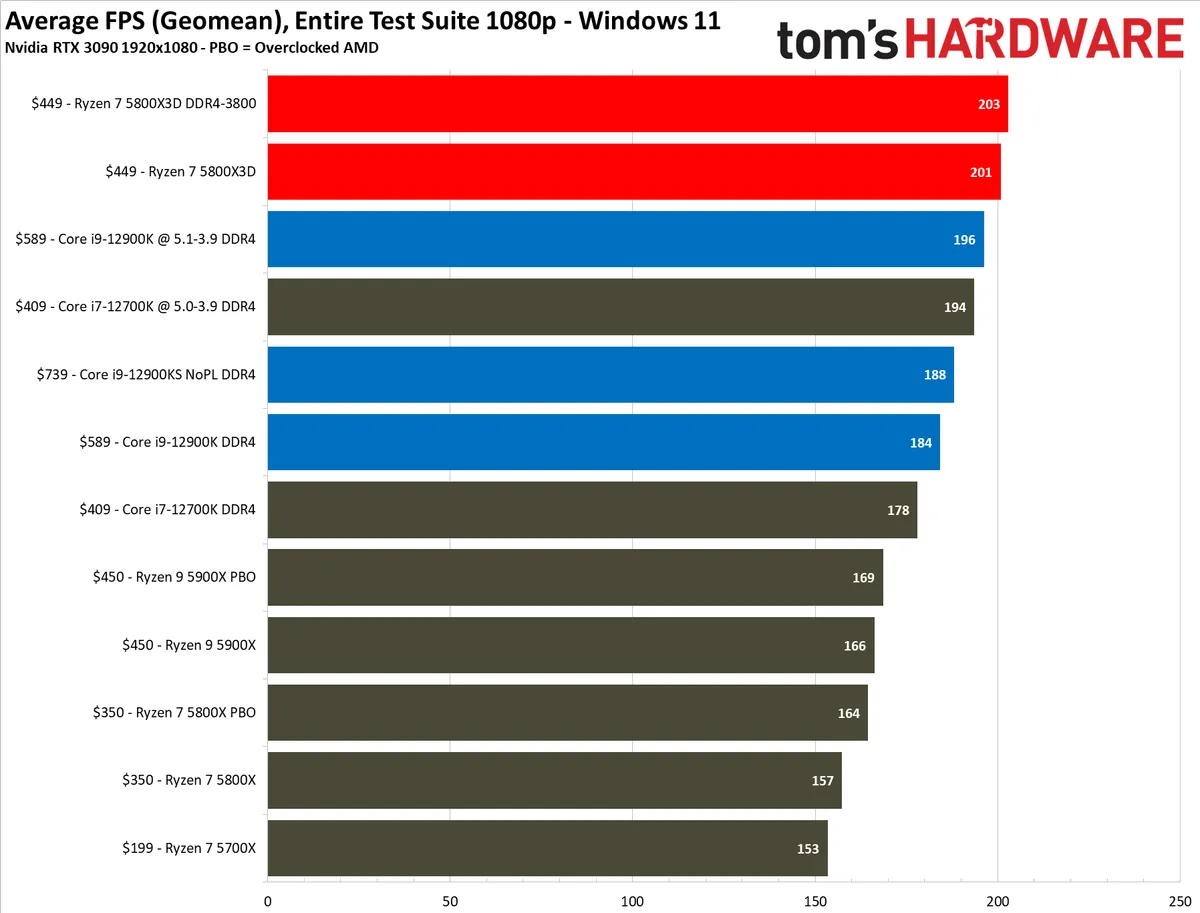
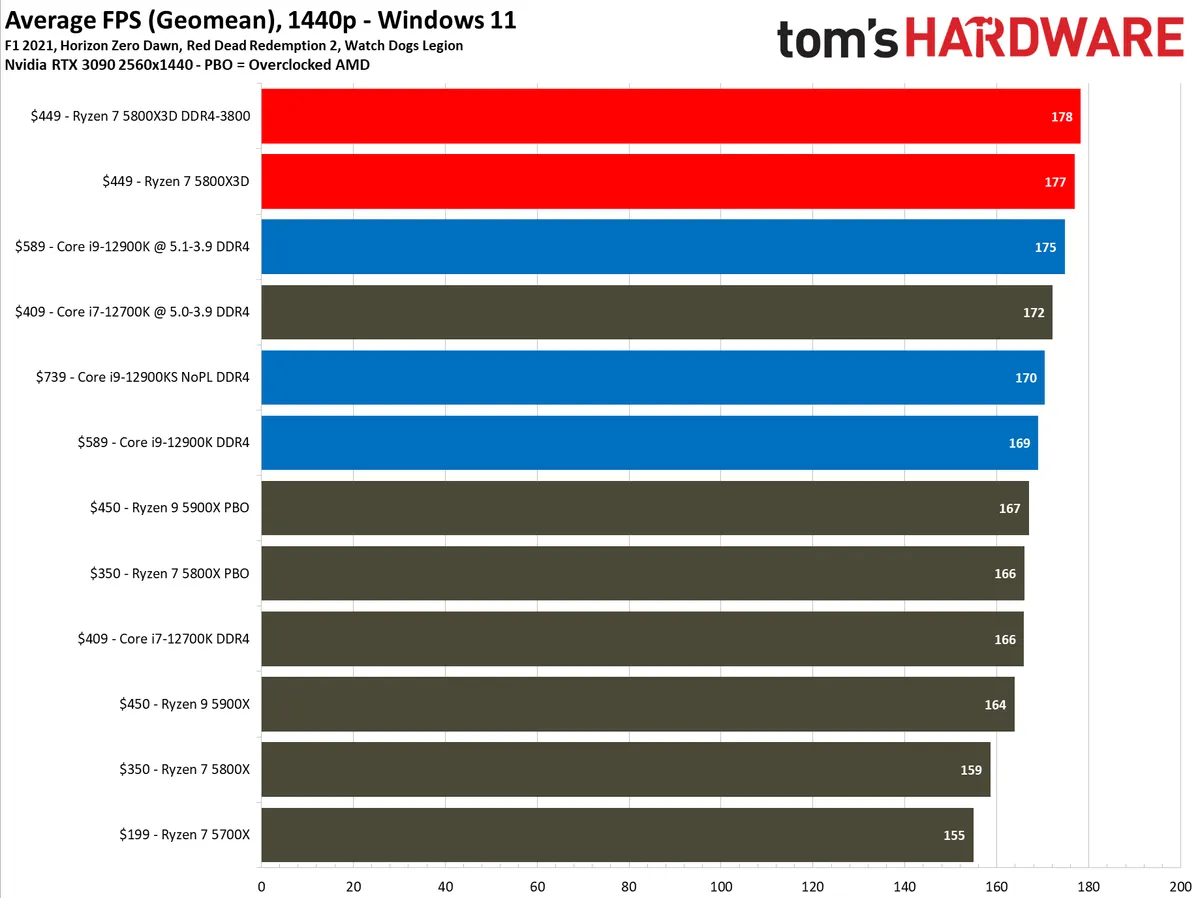
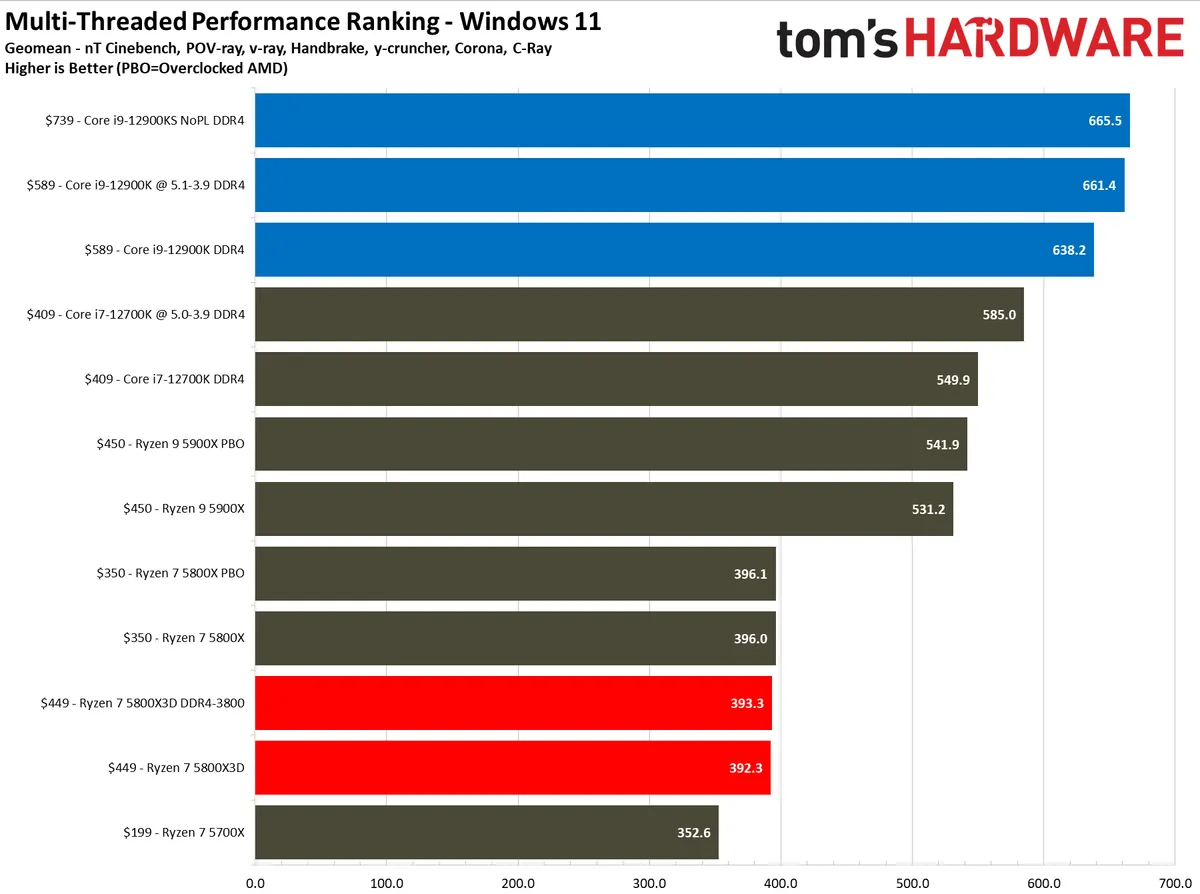
Here's a quick snapshot of the 5800X3D's average performance in our gaming test suite and key single- and multi-threaded applications. You'll find much more extensive testing on the following pages, but this gives you a good general sense of how the Ryzen 7 5800X3D stacks up.
As you can see, the Ryzen 7 5800X3D takes the crown as the fastest gaming chip in our test suite and lives up to AMD's claim that 3D V-Cache delivers an increase in gaming performance equivalent to what we would normally only see from a new microarchitecture. However, the 58000X3D isn't as fast as comparable chips in other types of single- and multi-threaded work beyond gaming. That's because the other models have a core count and frequency advantage. In fact, due to lower clock speeds than its most directly-comparable counterpart, the Ryzen 7 5800X, the 5800X3D is slower in some single-threaded applications.
However, while Intel's 12900KS still delivers leading performance in applications, its hefty $739 premium isn't as good of a buy as AMD's $449 Ryzen 7 5800X3D if you're solely interested in gaming. The same applies to the standard 12900K and 12700K, too, though the Core i7-12700K is a contender if you're looking for a more balanced blend of gaming and application performance around the $410 price point.
Of course, the Ryzen 7 5800X3D is a huge win if you already own a Ryzen system — this chip will drop into almost any AM4 motherboard, saving some cash if you have the right supporting components. Overall, the Ryzen 7 5800X3D is exactly what AMD says it is — a chip optimized specifically for gaming that takes the overall lead.
First, let's take a quick look at the specs, then get right to our full gaming and application test results. Be sure to look for the deep-dive details and testing on the 3D V-Cache, boost frequencies, and thermals later in the article (the latter is particularly interesting).
AMD Ryzen 7 5800X3D Specifications and Pricing
The Ryzen 7 5800X3D is the first consumer processor to feature 3D V-Cache, but the company also uses the tech for its Milan-X processors for the data center. 3D V-Cache leverages a novel new technique that uses hybrid bonding to fuse an additional 64MB of 7nm SRAM cache vertically atop the Ryzen compute chiplet, thus tripling the amount of L3 cache per Ryzen die.
Swipe to scroll horizontally
Row 0 - Cell 0
Street / MSRP
Cores | Threads
P-Core Base/Boost
E-Core Base/Boost
L3 Cache
TDP / PBP / MTP
DDR4-3200
Core i9-12900KS
$739
8P + 8E | 16 Cores / 24 threads
3.4 / 5.5 GHz
2.5 / 4.0 GHz
30 MB
150W / 241W
DDR4-3200 / DDR5-4800
Core i9-12900K / KF
$589 (K) - $564 (KF)
8P + 8E | 16 Cores / 24 threads
3.2 / 5.2 GHz
2.4 / 3.9 GHz
30MB
125W / 241W
DDR4-3200 / DDR5-4800
Ryzen 9 5900X
$450 ($549)
12P | 24 threads
3.7 / 4.8 GHz
-
32MB
105W
DDR4-3200
Ryzen 7 5800X3D
$449
8P | 16 threads
3.4 / 4.5 GHz
-
96MB
105W
DDR4-3200
Ryzen 7 5800X
$350 ($449)
8P | 16 threads
3.8 / 4.7 GHz
-
32MB
105W
DDR4-3200
Core i7-12700K / KF
$409 (K) - $384 (KF)
8P + 4E | 12 Cores / 20 threads
3.6 / 5.0 GHz
2.7 / 3.8 GHz
25MB
125W / 190W
DDR4-3200 / DDR5-4800
Ryzen 7 5700X
$299
8P | 16 threads
3.4 / 4.6
-
32MB
65W
DDR4-3200
The Ryzen 7 5800X3D comes with the same eight Zen 3 cores and 16 threads as the standard Ryzen 7 5800X but has a lower 3.4 GHz base and 4.5 GHz boost frequency within its 105W envelope. AMD trimmed 400 MHz from the base clock and 200 MHz off the boost frequency, but you get an additional 64MB of L3 cache in exchange, for a total of 96MB of L3.
Naturally, the 3D V-Cache tech has tradeoffs, with the most obvious being the $449 price tag — you’ll pay an extra $100 for the same number of cores as you’d get in the vanilla Ryzen 7 5800X.
The 5800X3D's big attraction is AMD's claim of an average 15% gain in gaming performance over AMD's fastest gaming chip, the Ryzen 9 5900X which also currently retails for $450. The 3D V-Cache doesn’t increase performance in other types of work beyond gaming, so compared to the 5900X, you’ll sacrifice four cores and eight threads in exchange for the extra cache, thus losing performance in some productivity applications. That means the Ryzen 9 5900X would be the better option for productivity-focused work, but you should also look to Alder Lake alternatives if you're after a more balanced performance profile.
The 5800X3D fully supports overclocking the memory and Infinity Fabric, but you can't overclock the CPU cores or use the auto-overclocking Precision Boost Overdrive feature (more detail below). The company cites a voltage limitation, but our thermal testing below certainly implies that heat dissipation is an exacerbating issue. AMD says this is the first iteration of the tech, and it is possible that overclocking could be enabled on potential future 3D V-Cache processors. However, the company hasn't officially committed to releasing other models in the future. Given the performance we've seen, it wouldn't be surprising to see this tech carry over into the Zen 4 era.
That won't stop enterprising enthusiasts from trying, though. We've already seen reports of limited BCLK overclocking that can eke out a few hundred extra megahertz (perhaps more on motherboards with external clock generators), and there appears to be a workaround to alter the motherboard's voltage output to the CPU, thus feeding the chip more voltage than AMD intended. Of course, the latter could incur significant risk, but we'll learn more in the coming weeks as enthusiasts put the silicon through the wringer.
As with all other 105W Ryzen 5000 chips, the Ryzen 7 5800X3D doesn't come with a cooler. The chip has the same thickness (Z-height) as all other Ryzen 5000 models, so it is compatible with the broad ecosystem of standard coolers for the AM4 socket. The 5800X3D will drop into existing 400- and 500-series motherboards (Socket AM4), and AMD’s upcoming BIOS updates will also enable support on older 300-series platforms. You'll need a BIOS with AGESA 1.2.0.6b (or newer) for the Ryzen 7 5800X3D.
AMD says that Ryzen 5000 support will vary by vendor, as will the timeline for new BIOS revisions. However, they should all be available now. Notably, these BIOS revisions will also include the fix for AMD’s fTPM stuttering issues.
The 5800X3D also doesn't support the leading-edge connectivity options, like DDR5 and PCIe 5.0, that you'll find with Alder Lake, but it does support up to DDR4-3200 and PCIe 4.0. AMD won't be able to match intel's connectivity tech until its 5nm Ryzen 7000 ‘Raphael’ Zen 4 CPUs arrive later this year.
Let's take a closer look at the overall architecture, power, and thermals, including thermal throttling testing, then move on to our gaming and application benchmarks.
The 5800X3D on the surface looks good. Not the $449 price tag to be sure as many of us given our ongoing dilemma at the gas pumps leaves little or no cash available for higher-end PC fares. Besides AMD being a latecomer to the party with a practically outdated and niche CPU and especially with an all new CPU and hardware generation sitting virtually on our doorstep! At this point in time I would think that many will ‘hold and fold’ until better economic times are in sight and mind. At the latest local computer show the 5800X3D came up in discussion and it was said: “Looks like a very nice chip, but at this late time it’s not a good investment!”
I see this the other way its a fantastic upgrade for those on AM4 that may still be on Zen+ or Zen 2 and will prolong the life of those systems a few more years. Leaving time for pricing to go down on DDR5 when its time to upgrade.
Clearly, something is wrong with the 12900ks sample used (or the setup) if it can't be overclocked at all, and especially if it is not faster than an overclocked 12700k.
Also, how could any conclusion be made without including 12900k/ks + DDR5 tests?
For example, from a TechSpot review, 12900k FarCry 6 performance was the following (no overclocking):
157 frames/sec - 12900k DDR4-3200
170 frames/sec - 12900k DDR5-6400
Details can be found in the "Gaming Benchmarks" section here:
https://www.techspot.com/review/2443-intel-core-i9-12900ks/
Even after benchmarking the 12900k/ks with DDR5, the 5800X3D might still be ahead in the geometric mean. But since DDR5 prices are dropping I think most people buying a 12900k/ks may end up using higher-end motherboards with DDR5 to squeeze out every last drop of performance. So, can you add some Alder Lake + DDR5 results, please? (thanks!)
I see this the other way its a fantastic upgrade for those on AM4 that may still be on Zen+ or Zen 2 and will prolong the life of those systems a few more years. Leaving time for pricing to go down on DDR5 when its time to upgrade.
This is me. I just upgraded from a 3700X to a 5800X3D. I’m going to get a couple more years out my B450 Tomahawk Max and 2x16gb DDR4. This is paired with a 3080 and 1440p 240Hz monitor. By the time I need to upgrade cpu DDR5 will hopefully be more mature, cheaper and actually bring beneficial improvements for games.
The only thing that I have noticed is my RAM seem to run hotter on the 5800X3D than the 3700X. It now runs at about 45-49c on stock XMP, previously 40-43.
While it may be the best in gaming for AMD's current offerings, other reviews, such as Techpowerup's, which use an RTX 3080, show the 5800X3D to lead by only 7.4% on vs the 5900X in gaming at 1920x1080 on average. Assuming you aren't using a ~$1500 3090 but a ~$900 3080, are you really telling us that you should buy the 3080X3D instead of spending, currently, $80 more on the 5950X, for twice the number of cores and a much better all around system?
While it may be the best in gaming for AMD's current offerings, other reviews, such as Techpowerup's, which use an RTX 3080, show the 5800X3D to lead by only 7.4% on vs the 5900X in gaming at 1920x1080 on average. Assuming you aren't using a ~$1500 3090 but a ~$900 3080, are you really telling us that you should buy the 3080X3D instead of spending, currently, $80 more on the 5950X, for twice the number of cores and a much better all around system?
The 5950X is outperformed by the 5900X for gaming, so if gaming is the main concern then it makes sense to compare to a 5800X or 5900X.
The 5950X is outperformed by the 5900X for gaming, so if gaming is the main concern then it makes sense to compare to a 5800X or 5900X.
True, but not in applications, which is half of this test, and the 5950X beats the 5900X quite handily due to having more cores. And since they compared it against an Intel processor with 16 cores, the 12900K, as well as the 12900KS variant, then they should have included a 16 core AMD processor as well for good measure, even though the 12900K and KS are quite a bit faster anyway.
True, but not in applications, which is half of this test, and the 5950X beats the 5900X quite handily due to having more cores. And since they compared it against an Intel processor with 16 cores, the 12900K, as well as the 12900KS variant, then they should have included a 16 core AMD processor as well for good measure, even though the 12900K and KS are quite a bit faster anyway.
True, but this review is about the 5800X3D which is being pushed as a gaming cpu, nothing more. Therefore it’s reasonable to compare on that basis. If you are not after a purely gaming cpu the 5800X3D probably does not make sense.
The biggest winners with the 5800X3D are AM4 owners; the people that actually trusted AMD and, well, they have fully delivered, I'd say. I personally didn't go with the 5800X3D, because the 5900X dropped to under $400 and that's just way too good as an upgrade (I got it for £370). I've gone through 3 Zen generations (2700X, 3800XT and now the 5900X) and while I still think the 9K gen from Intel is still good, I can't help but feel kind of sorry for them. Almost the same for 10K gen owners, but the 10700K is still a great CPU in my eyes and let's not talk about 11K gen.
Also, this thing is still 8 cores and 16 threads, it's not like it suddenly got degraded to a 4 core 8 threads CPU. I'm sure it should be fairly similar to the 11700K or at least 10700K and those you wouldn't say are slouches, no? Perspective is as common as the common sense, innit?
The biggest losers are people like me who bought a high end X370 motherboard trusting AMD to support all AM4 processors on all AM4 motherboards like they said at the beginning, then bought a X570 motherboard after they said no Zen 3 support on X370 motherboards only for them to then change their minds and actually support Zen 3 on X370 motherboards...