Join for quick access. Enter your email below and we'll send confirmation plus sign you up to our newsletter.
By submitting your information, you confirm you are aged 16 or over,
have read our
Privacy Policy
and agree to the
Terms & Conditions. Geographical rules apply.
Stay On the Cutting Edge: Get the Tom's Hardware Newsletter
Get Tom's Hardware's best news and in-depth reviews, straight to your inbox.
You are now subscribed
Your newsletter sign-up was successful
Join the club
Get full access to premium articles, exclusive features and a growing list of member rewards.
An account already exists for this email address, please log in.
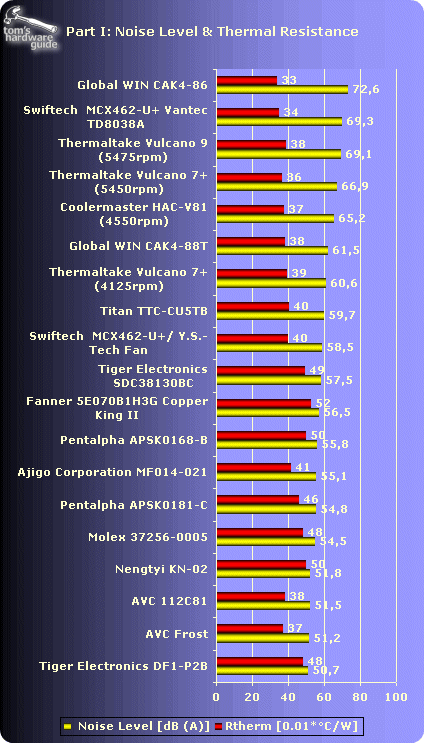
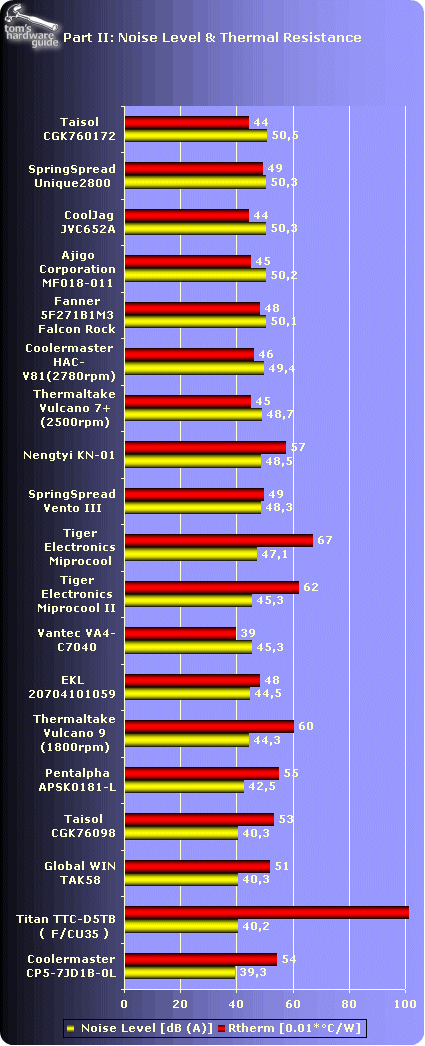
The noise level of the tested fans varies according to the model, from an extremely quiet, barely audible 38 dB(A) (which can be compared to a loud whisper) up to an annoying 67 dB(A) (loud talking).
To compare the noise of the fans, you should go by the following rules of thumb: twice the volume is equivalent to an increase in the noise level of 10 dB(A); four times the volume is therefore equivalent to an increase in the noise level of 20 dB(A); differences of 1 dB are virtually inaudible, while differences of 3 dB(A) are clearly noticeable.
Please note that the measurements were taken at a constant ambient noise level of 34dB(A) with the housing opened, at a distance of approximately 35 centimeters from the fan wheel. Consequently, the levels will be considerably lower than our results when the housing is in place.
The thermal resistance is the decisive value in this test. It is the measure for the cooler's performance capacity . It is calculated from the processor's power loss ratings PV , the die temperature TD and the surrounding temperature TA , according to the following formula:
Rtherm =(TD -TA )/PV in °C/W
The die temperature is an operand only. Its value during the test is influenced to a great extent by the CPU's power loss rating and can vary greatly, even with similarly rated clock speeds. "Our" Athlon-XP 2400+ scored a maximum power loss of 57 Watts. According to the data sheet, however, the Athlon-XP 2400+ can devour up to 68 Watts. If you were to operate these two 2400+-CPUs using the same cooler, with a thermal resistance of, say, 0.5°C/W, the die temperature of the THG 2400+-CPU would be around 5.5°C cooler.
Stay On the Cutting Edge: Get the Tom's Hardware Newsletter
Get Tom's Hardware's best news and in-depth reviews, straight to your inbox.